
INTRODUCTION
GROSS DOMESTIC PRODUCT (GDP)
The Gross Domestic Product (GDP) in Nepal increased almost seven times during last 25 years, 1990-2015. It elevated from US$3.63 billion in 1990 to US$21.2 billion in 2015 (Figure 1). Until 2000, the GDP could not grow beyond US$5.49, but tripled by 2010 with US$ 16 billion. Following five years, on the contrary, could not add more than US$ 5.19 billion to the national GDP. Nepal’s progress in GDP is a blend of rapid incline and decline. 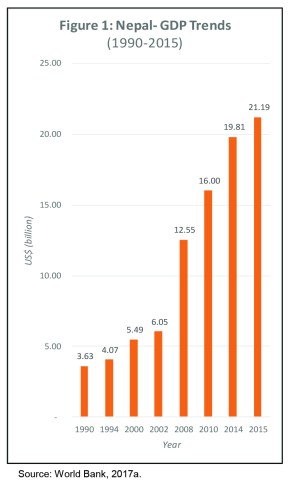 The highest annual growth rates were achieved in 1994, with 8.2 percent, followed by 6.2, 6.1 and 5.9 percent in 2000, 2008 and 2014 respectively. The worst performance regarding annual GDP growth was witnessed in 2002 and 2015 with 0.12 and 0.72 percent correspondingly. The lowest growth rate in 2000 caused by the heightened armed violence during Maoist Conflict and 2015 witnessed two devastating earthquakes during the first half and the controversy over new constitution during the second half of the year. It is worth to note that Nepal is situated between India and China who observed 7.93 and 6.91 percent of GDP growth in 2015. Regarding sector-wise contribution to the national GDP, Nepal is witnessing a decline in agriculture, industry and manufacturing except the service sector’s contribution increased from 37 percent in 2000 to 52 percent in 2015. During the same period, a decline of 8 percent in agriculture, 7 percent in industry and 3 percent in manufacturing was observed (World Bank, 2017b).
POVERTY IN NEPAL
Poverty Measurement in Nepal
Nepal follows the Cost of Basic Needs approach (CBN) to estimate poverty (CBS, 2011a: 14). CBN approach defines poverty line as the expenditure value, in local currency, required by an individual to meet the basic needs regarding food and non-food items. The food basket of the poverty line is constructed by estimating how much a person (poor) spends to reach a minimum calorie requirement of 2,220 kcal per day. Calorie intake per capita per day is based on FAO’s standard (FAO, 2008: 10-12). On the other hand, non-food measurement is based on the assumption that a household whose food consumption is close to the food poverty line will spend the minimum required to fulfil non-food requirements (CBS, 2011a: 15). 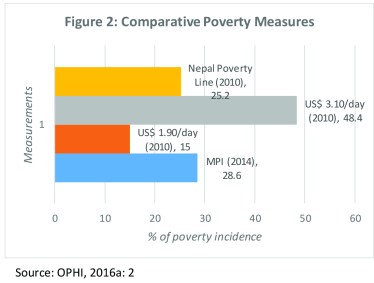 Based on the food and non-food poverty line, the overall poverty line is defined. NRs. 19,261 is estimated as poverty line in Nepal; NRs. 11,292 as food poverty, and NRs. 7,332 as non-food poverty line (2011a:16). In short, anyone with less than NRs. 19,261 (equivalent to US$ 180) per capita consumption is officially considered poor in Nepal. Based on the national measurement of poverty, 25.16 percent of the people in Nepal are living below the poverty line. The percentage of poor, however, differs by poverty measures. For example, only 15 percent of the national population is poor if measured by US$ 1.190 a day (Figure 2). But, Multi-dimensional Poverty Index records 28.6 percent of the national population as poor whereas the figure goes up to 48.4 percent if the poverty measurement is based on US$ 3.10 a day (OPHI, 2016a).
Nepal witnesses decline in poverty headcount rate since 1995/96. The poverty rate was 41.8 percent in 1995/96 which dropped by 11 percent in 2003/04 (CBS, 2005:2). And by 2010/11, poverty declined to 25.16 percent (CBS, 2011a:16).  During these years, urban areas constantly performed better than the national average. Poverty trends in urban areas experienced a decrease from 21.55 percent in 1995/96 to 9.55 percent in 2003/04, but it increased to 15.46 percent in 2010/11 (Figure 3). On the contrary, rural poverty has remained as a core challenge which experiences more incidences of poverty than urban and even above the national average. Although rural areas experienced higher progress regarding poverty incidence, by 15.84 points during 1995/96-2010/11, compared to 6.09 points in urban areas, the poverty rate is still persistent in rural areas.
HUMAN DEVELOPMENT INDEX
Nepal scored 0.558 HDI value in 2015 securing 144 out of 188 countries and territories in the world (UNDP, 2017:3). Between, 1990 and 2015, Nepal witnessed an increase of HDI by 47 percent, 0.378 in 1990 to 0.558 in 2015 (Figure 4). The HDI indices of Nepal also show positive changes during the same period. Life expectancy at birth increased by 15.7 years, mean years of schooling increased by 2.1 years and expected years of schooling increased by 4.7 years. 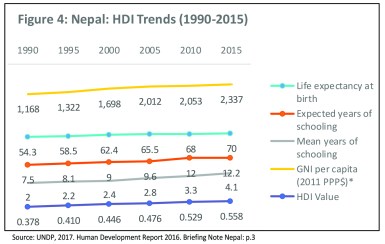 Concerning Gross National Income (GNI) per capita (PPP$), Nepal observed a progress from US$ 1,168 in 1990 to US$ 1,322 in 1995 and US$ 1,698 in 2000. The GNI per capita moves upward ever since. However, per capita growth rate is not as progressive as the GDP growth rate. The GDP growth observed over seven times increase since 1990 widening the gaps in the areas of income, poverty and human development in the country. The UNDP (2017:4) claims that although Nepal’s HDI for 2015 is 0.558, the HDI falls to 0.407. This is 27.0 percent loss due to the inequal distribution of HDI indices; life expectancy, literacy and income.
Inequality in HDI: region and social groups
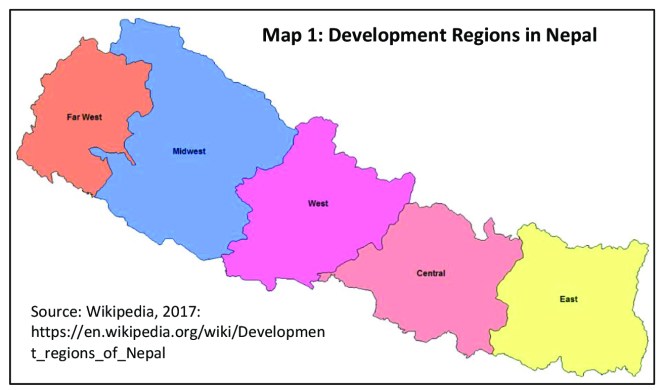 The HDI values within Nepal differ from one region to the other. The lower HDI reflects the weaker state of human development whereas the higher shows the improved level of empowerment. Regarding the development regions, the Mid-West had the lowest position (0.402) followed by Far West (0.404) in 2001 (Table 1).
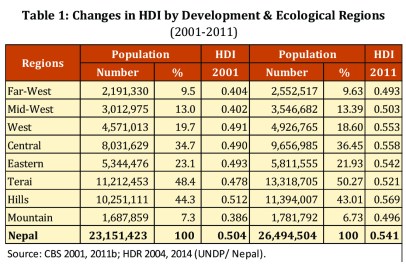 Ecologically, Nepal is divided in three regions: Mountain, Hill and Tarai. In terms of ecological region, Mountain region was the least progressing comparing to Hill and Tarai, during 2001-2011. But the scenario changed in 2011 as Mid-West topped Far-West. The Eastern region declined from the top (0.493) to third (0.542) in 2011. On the contrary, the Central region, which had scored the third rank with 0.490 in 2001 progressed to the top in 2011 scoring 0.558, despite the population growth by 2.5 percent. Hills consistently remained above the national average during 2001-2011 followed by Tarai, and both of the ecological regions observed population growth except in Mountain region witnessing a decline.
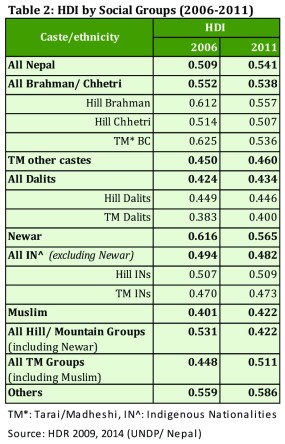 Differences in the HDI indices are not merely limited to the ecological and development regions in Nepal. The inequality is significant across social groups despite their geographic concentration. The disparities in human development have continued for longer than what is illustrated here (Table 2), as noted by the Human Development Report since 1998 (UNDP, 2014). Of 125 caste/ethnic groups in Nepal, Newars have remained at the top of the HDI so far and Brahman and Chhetri, both Hill and TM, have enjoyed the human development above national value. Dalits, indigenous nationalities (excluding Newar) and Muslim have ranked below the national HDI value. Nevertheless, the inequality between and within these groups are notable. Hill indigenous nationalities rank better than Tarai/ Madheshi (TM) indigenous nationalities whereas Hill Dalits stand higher than Muslim and TM Dalits.
During 2006-2011, the HDI value for Nepal improved by 0.032 whereas it declined notably in TM Brahman/Chhetri, Hill Brahman and Newar by 0.089, 0.055 and 0.51 respectively. Despite Muslim, TM Dalits and TM Other Castes benefitted during the same period, they still rank at the bottom of HDI by caste and ethnic groups.
POVERTY DYNAMICS
Multi-dimensional Poverty
Nepal secured a score of 0.350 in multidimensional poverty (MPI) in 2006 and progressed to 0.217 and 0.124 in 2011 and 2014 respectively (OPHI, 2016a & b). Comparing the MPI dimensions, the highest progress Nepal has made during 2006-2014 is in living standard, by 32.9 points, followed by 30 points in health and the least in education with 10.7 points (Figure 5). 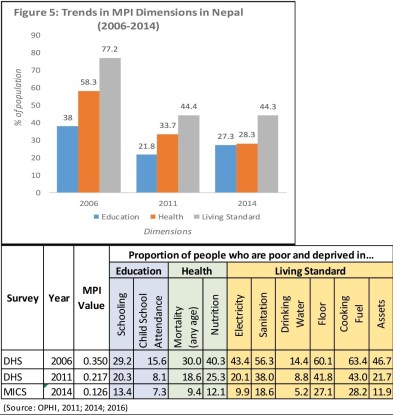 Although Nepal entertained the highest improvement in living standard, progress regarding access to drinking water is among the lowest indices, mere 9.2-point progress so far. Among health indices, positive change in mortality rate, from 30 to 9.4, and from 40.3 to 12.1 points in nutrition were observed. The education indices experienced the least growth where schooling improved by mere 10.7 points and school attendance remained at the bottom of all ten indices, with 8.3 points change during 2006-2014.
Uneven Share of Income and Consumption
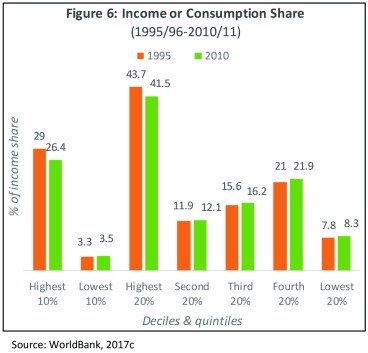 There has been a positive increase in the consumption and income of Nepalese population. Per capita consumption increased from NRs. 6,802 in 1995/95 to NRs. 34,829 in 2010/11 (CBS, 2011c:37-39). Similarly, average income increased from NRs. 43,732 to NRs. 202,374 between 1995/96 and 2010/11, over 363 percent. And Nepal has also made a slight improvement in GINI Index; from 35.2 in 1995/96 to 32.8 in 2010/11 (WB, 2017c). However, the growth in consumption and income also widens the gap between rich and the poor. Regarding consumption share, there has been a very nominal change of consumption ratio between the top and lowest quantiles. The poorest twenty percent account for mere 8 percent but the richest twenty percent account for 41 percent of the total consumption (Figure 6). Regarding income share, the income of the lowest 10 percent increased by 375 percent whereas the riches 10 percent enjoyed 512 percent increase during the 1995-2010.
Poverty by Occupation
Poverty in Nepal also varies by the occupation of the household head. Households led by agricultural wage labourers are the poorest of all other occupations. Poverty incidence of these households was almost 56 percent in 1995/96 and witnessed a decline of 8.87 percent by 2010/11, less than 0.6 percent per year for last 15 years (CBS, 2005: 15-16; NLSS/CBS, 2011a:20-21). The households of agriculture wage earner accounted for 11.7 percent of the national population and consisted of 15.7 percent of poor in 1995/96, have reduced to 3.4 percent of the population in 2010/11, with 6.3 percent of them as poor (Table 3).
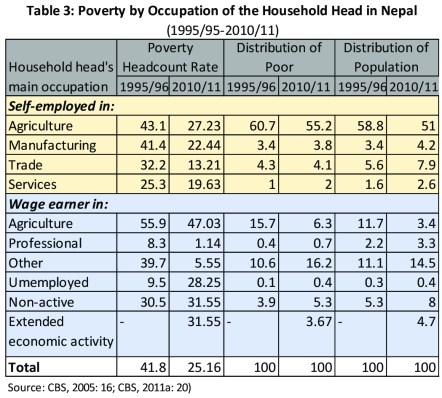 The second poorest groups in Nepal also belong to agriculture-dependent households. Those self-employed in agriculture accounted for 43.1 percent, of poverty headcount, in 1995/96 have reduced to 27.23 percent in 2010/11. Unlike wage earner, the self-employed households in agriculture halved the poverty incidence during the same period. However, self-employed households in the agriculture sector are the most populous occupational groups of all. They constituted 58.8 percent of the total national population with 60.7 percent poverty headcount in 1995/96 and have experienced insignificant decline by 2010/11. On the contrary, households headed by professional wage earner maintained the lowest poverty headcount rate since 1995/96. Although Other wage earning households witnessed a decline of poverty incidence, their share of national and poor population observed a considerable rise. The same trend applies to the wage-earners in non-active and unemployed sectors. These figures reflect the vulnerability of households, other than agriculture and professional sectors that they are fragile to fall into the poverty trap if stay away from income generating activities for long.
Poverty by Regions
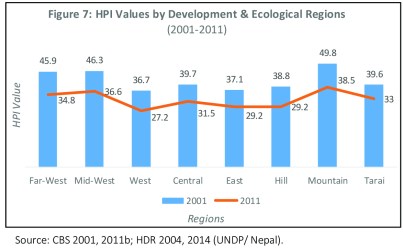 The HDI shows the increase in opportunities and choices whereas the Human Poverty Index (HPI) focuses the denial as a result of income and capability deprivation. The national value of the HPI for Nepal is 31.12, in 2011 (UNDP, 2014: 21). Maintaining the lead alike HDI, the Hills also dominate the HPI (Figure 7). It remained as an ecological region with lowest in HPI, above the national average- 39.6 in 2001 and 31.12 in 2011. Mountain and Tarai have scored less than the national MPI. Moreover, the decline in the HPI also observed the disparity. For example, the value of the reduction in the HPI was 8.48 for Nepal, 11.3 for Mountain, 9.6 for Hill and the least changes occurred in Tarai with just 6.6 (Figure 6). Comparing the five development regions, Mid-West and Far-West observed higher poverty than others. West region experienced the least HPI values among the five development regions, 36.7 in 2001 and 27.2 in 2011. On the positive side, the improvement in the HPI value was significant in Far-West, by 11.1 deductions. The value declined by 9.7 in Mid-West, 9.5 in West, 8.2 in Central, and the slowest in Eastern region with 7.9 which was less than the national value.
Poverty by Social Groups
Nepal Living Standard Survey further reasserts the inequality across caste/ethnic groups. The poverty headcount was 25.2 percent in Nepal, in 2011 (CBS, 2011b:5-10). Dalits constitute the largest number of people living below poverty line, 43.6 percent in hills and 38.2 percent in TM. TM Other Castes and Hill indigenous nationalities follow Dalits in poverty incidence with 28.7 percent and 28.3 percent respectively (Figure 8). Newars (10.25%) and Hill Brahmans (10.34%) have the least share of poverty.
 The imbalance is significant within Hill caste and ethnic groups. Hill Chhetris have over 13 percent more poor population than Hill Brahmans and Newars. Hill Dalits have the widest difference, over 33 percent, with Hill Brahmans and Newars. Moreover, the difference between Newars and other Hill indigenous nationalities is more than 17 percent. On the contrary, the gap is narrow between TM Other Castes and TM indigenous nationalities, about 7 percent. However, TM Dalits experience more than 19 percent poverty incidence rate than TMBC. The inequality is also notable between Dalits and indigenous nationalities. Hill indigenous nationalities have less than 15 percent incidence of poverty comparing to Hill Dalits whereas TM indigenous nationalities have 12 percent gap with TM Dalits. On the other side, poverty among Muslim population is 20.2 percent which is over 9 percent more than Hill Brahmans and Newars but less than 18 and 6 percent compared with indigenous nationalities and Dalits in Tarai/Madhesh. It is important to reflect that dominant groups suffer less from poverty incidence than the non-dominant and minorities even in geographically remote areas.
CONCLUSIONS
Nepal has made some notable achievements in terms of poverty reduction and living standards. GDP grew by seven times, and HDI improved by 47 percent during 1990-2015. Nepal met its MDG target of halving the poverty in less than seven years; 41.8 percent of the poverty rate in 1995/96 declined to 25.16 percent in 2010/11. The latest figure is 23.8 percent in 2014. GINI per capita increased over three times; from US$210 in 1990 to US$730 in 2015 and per capita consumption rose by almost six times during the same period. There, however, exist many challenges of poverty reduction which cannot only backtrack the gains achieved so far, but also erect new obstacles in meeting new ambition; upgrade to the middle-income country by 2030.
Poverty in Nepal is caused by many factors but is closely linked with the occupation of the household head, geographic remoteness, access to facilities, and social structures that influence how different caste and ethnic groups benefit from resources and opportunities. Over 76 percent of the total households in the country are agricultural households, and they also constitute the highest poverty population comparing to other occupations. Income sources have gone through far-reaching changes during 1995- 2010. Share of farm-based income dropped from 61 percent to 28 percent whereas the share of non-farm-based income increased from 22 percent to 37 percent (CBS, 2011c: 38-49). Over half of the total households in the country, 56 percent, receive remittance in 2010/11 which is 33 percent increase since 1995/96. However, income from remittance is mostly used in non-productive but essentials items of daily consumptions. Nepal’s excessive dependency on remittance is the primary driver behind improved living conditions but is not helping to improve the preconditions, such as infrastructure, education and health care, much needed to tackle poverty. Furthermore, low productivity, weak economy and lack of competitiveness can lead the country toward low growth and high-migration equilibrium and is likely to remain a key phenomenon in the years to come (Cosic et al., 2017: x).
As stated earlier, Nepal has made some progress regarding GDP, HDI, per capita consumption and income. However, the overall progress has also widened the gap between rich and poor; dominant and minority; educated and illiterate; and rural and urban population. Income and consumption of Nepalese people have increased significantly during 1995 and 2010. However, the growth rate varied by rich and poor. For example, in 2010, the bottom twenty percent accounts for 8.3 percent whereas the top twenty percent occupies over 41 percent which shows almost no change compared to the trends in 1995. Progress regarding equitable distribution of sources is very slow. The GINI Index for Nepal is lately 32.8, in 2010, corresponding to 35.2 in 1995. The disparity of poverty ratio is also significant across social groups in the country. For instance, Hill Brahman and Newar have the least poverty rate, 10 percent, whereas Hill Dalits witness the highest poverty headcount, 43 percent. Within Tarai/Madheshi groups, Brahman/Chhetris entertain 10 percent less poverty than Other Castes. Centralised and hierarchical social structures, poor access to health, education and income opportunities force the non-dominant groups in the society to benefit less from development achievements and economic growth. Besides, geography also plays crucial role in shaping the poverty dynamics. Poverty is more prevalent in Mountain and Tarai ecological regions than the Hills. While Mid-West and Far-West development regions have witnessed some progress regarding poverty reduction, these two regions are still behind others. However, poverty incidence spreads across all regions, in particular in the areas with lack of basic infrastructures, such as road, market, school, health post, communication and banking facilities.
There are also external factors that can suddenly change the course of action. Nepal is highly susceptible to shocks; whether natural, economic or political. Vulnerability to environment challenges such as frequent landslide, flood, drought, forest fire and very diverse climatic conditions pose relentless challenges to national priorities. For example, the devastating earthquakes in 2015 are expected to increase poverty by 2-3 percent. Trade and budget deficit, high inflation, and slow reform process, backed by frequent and sudden political developments are other strategic elements limiting Nepal’s endeavours to reduce poverty and pursue its national goal of shared prosperity and graduation to the middle-income country.
(A video documentary is conceptualised based on this article and can be viewed at https://www.youtube.com/watch?v=GqFwoRzhyHg&t=15s)
REFERENCES
CBS, 2001. National Population and Housing Census 2001. Kathmandu.
CBS, 2005. Poverty Trends in Nepal (1995/96-2003/04). Kathmandu. pp.1-25.
CBS, 2011a. Poverty in Nepal: Nepal Living Standard Survey. Kathmandu, pp. 5-22.
CBS, 2011b. National Population and Housing Census 2011: Social Characteristics Tables, 5(II). Kathmandu.
CBS, 2011c. NLSS 2010/11: Highlights. Kathmandu, pp. 37-38.
Cosic, D., Dahal, S., & M. Kitzmuller, 2017. Climbing Higher: Toward a Middle-Income Nepal. Country Economic Memorandum. Washington, DC: World Bank., p.x.
FAO, 2008. FAO Methodology for the Measurement of Food Production: Updating
the minimum dietary energy requirements., pp.10–12.
JICA, 2003. Poverty Profile Executive Summary Kingdom of Nepal., pp.1–2.
OPHI, 2011. Main MPI Results 2011. Available at: http://www.ophi.org.uk/wp-content/uploads/Copy-of-2011MPI_tables_17042011.xls.(10/05/2017)
OPHI, 2014. Multidimensional Poverty Index 2014: Brief Methodological Note and Results. Oxford, Oxford University.
OPHI, 2016a. OPHI Country Briefing Nepal., pp.1–10. Available at: http://www.ophi.org.uk/multidimensional-poverty-index/mpi-country-briefings/.(10/05/2017)
OPHI, 2016b. Multidimensional Poverty Index Winter 2016: Brief methodological note and results. Oxford, Oxford University. Available at: http://www.ophi.org.uk/wp-content/uploads/Tables_1_2_National-Results_MPI-2016_winter.xlsx (10/05/2017)
UNDP, 2004. Nepal Human Development Report 2004: Empowerment and Poverty Reduction. Kathmandu.
UNDP, 2009. Nepal Human Development Report: State Transformation and Human Development. Kathmandu.
UNDP, 2014. Nepal Human Development Report 2014: Beyond Geography, Unlocking Human Potential. Kathmandu.
UNDP, 2015. Briefing note for countries on the 2015 Human Development Report: Nepal. , pp.1–7.
UNDP, 2017. Briefing note for countries on the 2016 Human Development Report-Nepal. , pp.3–4.
WB, 2017a. Databank: World Development Indicators. Available at http://databank.worldbank.org/data/reports.aspx?source=2&country=NPL (10/05/2017)
WB, 2017b. World Development Indicators: Structure of output. Available at http://wdi.worldbank.org/table/4.2 (10/05/2017)
WB, 2017c. Poverty and Equity Country Dashboard: Nepal. Available at: http://povertydata.worldbank.org/poverty/country/NPL. (10/05/2017)
 Rakesh Karna