
INTRODUCTION
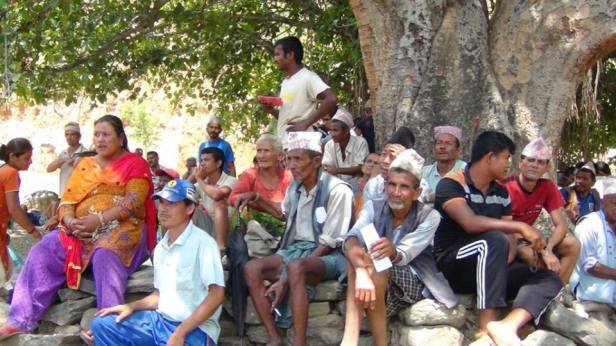
- Earthquake victims waiting for relief materials in Dolakha (Nepal). (C) 2015, Rakesh Karna
With the end of the Cold War, the political and social transformation of the countries around the world drew attention towards identity issues such as class, ethnicity, nationality, and majority-minority relationships. The politics of neoliberalism shifted the focus from society or community to individual liberty. Global migration trends, market-state nexus, interchange from government to the quality of governance, and increasing gap between economic growth and social justice led to growing concern over the protection of particular groups; individual or group of people with minority identity, not in a dominant position in the society.
What is more important in the minority rights discourse is the question whether it is just the intention that demand for equality. It is, quite the reverse, not just the good intentions for peace and stability that incite minorities’ concern, but rather the various international norms that seek protection and promotion of the people belonging to minority groups. Contemplating the epitome of social justice, equality and empowerment of all human being, it is essential to develop accommodative legal and social norms to integrate different race, caste, class, ethnicity, linguistic and religious backgrounds into the mainstream of national, regional and international systems.[I] The delay in incorporating minorities’ agenda in the mainstream discourse can push them in the ‘precariat’ group [iii] at the discretion of power players, a term defined by Gary Standing as a new class formation in the twenty-first century (2011[ii]).
This paper looks at how minorities are broadly conceived, why they need special treatment and which international treaties and instruments are put in place to protect and promote their rights. The discussions assess the definition of scholars and experts in the minority and indigenous issues, relevant international practices and the development of minority specific arrangements. In the end, I will conclude whether there has been promising environment for the minorities and the adoption of international frameworks at the national level.
MINORITIES AND INDIGENOUS PEOPLES
Post-Cold War era brought the wave of democratisation across the world and those suppressed and ignored, so far, began drawing the attention of welfare states. The weaker and fragile states, especially in multi-ethnic societies, could not adequately accommodate the diversity in state building efforts leading to tensions and further suppression of non-dominant voices. Although the identity and ethnic dimensions do not necessarily result in violent conflict, it certainly fuels and helps in enduring the insurgencies. Concerns have, since then, been raised to the inadequacy of international systems in recognising the grievances of minority groups. In response to those growing concerns, some attempts are made to safeguard the rights of individual, or groups, based on class, ethnicity, religion or language, not practiced by the majority, in global human rights and governance systems.
Defining minority groups
The evolving nature of political dimensions, legal status, and their realisation greatly shapes the preconditions and understanding of minority groups. The fluidity of such dimensions complicates the widely-accepted definition. Although, there is not any universally accepted or used definition of ‘minority group’ in the international systems, various UN bodies and rights organisations have continued to practice a working definition. The definition, by Francesco Capotorti, has been used by many in theory and practice. Capotorti defines a minority groups as:
A group numerically inferior to the rest of the population of a state and in a non-dominant position, whose members – being nationals of the state – possess ethnic, religious or linguistic characteristics differing from those of the rest of the population and show, if only implicitly, a sense of solidarity, directed towards preserving their culture, traditions, religion or language.[iv]
Capotorti (1976)[v] further elaborates the primary criteria to define a minority group: numerical inferiority; non-dominant position in relation to the population as a whole; differences in ethnic/ religious/linguistic characteristics and traditions of such group comparing to the rest of population; and wish to preserve unique nature of their culture and tradition. Whereas the first three benchmarks are neutral, the fourth is individual and, so the individual or the group should deter- mine the association with minority identity. While Capotorti’s definition of minority groups is widely used, it is not the absolute. The UN, for instance, has continually revisited the definition to make it more contextual to the changing political dynamics (OHCHR, 2007).[vi]
In simpler term, ‘minority group’ is a non-dominant group, of individuals, who, I) share particular ethnicity, language or religion and that are different from those in dominant power positions, and II) who may be at the risk of exploitation and discrimination because of the ‘dissimilar’ identity or position. Self-definition and the wish to preserve own identity has been recognised as main features while understanding the minority status. Although these criteria and features are widely used, they are yet to be explicitly defined in the international body.
Despite the persistent brawl to agree on a universally accepted definition of a minority group, many countries, National Commission for Minorities in India for example, have attempted to recognise the collective rights of specific groups through institutional arrangements. However, state authorities often face criticism from minority organisations due to the narrowly-focused definition and short-criteria. Non-government organizations weigh more on defining a minority group based on their common identity, culture, ethnicity, language or religion and their helplessness in participating in and affecting the decision making structures. Group-specific measures in the law should be able to protect and promote their rights with an aim to eventually empowering them alongside the fellow dominant groups. Moreover, minorities need these legal protection mechanisms to remain least affected by the simultaneous development of anti-minority behaviours and involuntary assimilation in the dominant culture. Thus, the formal definition should integrate the broader characteristics of minority communities to allow unprejudiced and wider representation.
Defining indigenous peoples
Development organisations, state agencies and the indigenous scholars tend to employ two definitions while describing indigenous people: first by José R. Martinez Cobo, Special Rapporteur appointed by the UN Sub-Commission on the Prevention of Discrimination and the Protection of Minorities; and second as highlighted in Article 1 of International Labour Organization (ILO) Convention No. 169 of 1989 (Janet, 2002).[vii] Globally, the indigenous people are defined or understood as those, who hold historical continuity with the land before the formation of a country, and face discrimination in the contemporary society because of their distinct identity, and cultural uniqueness. The UN Working Group on Indigenous Populations (WGIP)[viii] offered a definition based on four criteria derived from various studies and expressions, of international organisations, academia and legal experts:
- priority in time;
- the voluntary perpetuation of cultural uniqueness;
- self-Identification as indigenous people, as well as external recognition as such, including by authorities; and
- the experience of suppression, exclusion, and discrimination by the dominant groups in the society.
WGIP addresses many shortcomings of the previous definitions. Also, the expansion of definition beyond the priority-in-time, de-emphasizes tribal components and does not make colonisation the sole condition for indigenousness. This definition is more reflective of new indigenousness. The definitions by ILO and UN suggest that self-identification and a collective desire to preserve practices that differ from mainstream society are the most important aspects of defining indigenous identity. Self-identification reproduces an ongoing group awareness which continues to form their common identity.
Do indigenous peoples need separate provision?
Globally, some groups can be classified as minority and indigenous as well is a common practice. The adoption of the UN Declaration on the Rights of Indigenous People 2007, or DRIP in short, signalled that international law distinguished between the rights of minority groups and those of indigenous peoples (Alfredsson, 1995).[ix] However, there is overlap between the general case of minority and the particular case of indigenous people (Thornberry, 1991).[x] Some even claim that the concept of indigenous people and minorities are logically and legally interrelated (Daes, 2001).[xi] Although indigenous peoples entertain all the rights voiced for minorities, the UN Declaration on Minorities (1992) do not necessarily satisfy all the needs and aspirations of the indigenous people. The DRIP has indigenous group specific elements which include significant collective rights such as the right to self-determination and land.[xii]
Another reason behind the need of additional rights for the indigenous people is that they do not always require special financial support or attention to improving their wellbeing and practising their unique culture. They, rather, have been living and enjoying before the formal boundary of a state was introduced and laws and regulations were imposed (Kuppe, 2009).[xiii] More often, recognition of their distinct culture and traditions are enough to protect and promote their rights. Furthermore, the cross-border relationship among the indigenous peoples is another reason why they need specific provision. The dominant groups may perceive this cross-border relationship as a threat to the collective and national identity and culture. This situation can lead to the institutional and structural marginalisation of indigenous people.
Do minorities need special attention?
Political scientists, such as Will Kymlicka, elaborate that modern states have two choices of ensuring minority rights; one by integration and the other by accommodation. Both eventually lead to either assimilation of the minority groups in the national cultural mainstream or accommodation of their ‘different’ identity and culture through separate institutions or practices. Integration approach upholds individual rights but less stress on collective rights. On the contrary, accommodation approach typically leads to enduring collective rights.
The situation of African American in the United States is a lesson to understand the limitations of the integrative approach. The US has long held the ‘melting pot’ approach that seeks to in- corporate all members of its society into a single American culture. The case of African-Americans, however, shows that the integration can overlook deeper forms of exclusion and denial of their cultural identity. Notwithstanding the state granting individual rights to African American minorities, the epistemological canon of ‘colour-blindness’ combines with the ethos of individual choice to preserve America’s racial hierarchy just as surely as did Jim Crow’ (Hayman & Nancy, 1993).[xiv] Kymlicka (1995)[xv] firmly proposes a need to review the integrative approach which is more complex than accommodation to address the issues of African-Americans. He further asserts, based on empirical evidence, that, unlike many immigrant communities, minorities and indigenous people would prefer accommodation rather than integration.
In the accommodative approach, a system, preferably legal, is required to protect the minority groups as they desperately need recognition and protection to ensure that they can entertain same rights as their fellow majority (dominant) groups. In many diverse societies, the dominant group’s history, culture, language, religions and socio-economic status put these groups in a position that is arduous enough to be challenged by the minority groups. It usually decomposes the distinctiveness of minority identity and culture and forces them to ‘blend in’ or assimilate in the dominant circles to avert further exclusion and exploitation. The state apparatuses, market, mainstream politics, mass media, and the lifestyles of the dominant groups primarily initiate and sustain these pressures to assimilate. Undesirably, these pressures not only subdue the identity and cultures of the minority groups but also overwhelm their self-esteem and desire to contribute to the national life.
The ideal of a democratic legal system should be based on the valid social consent of both the dominant and minority groups apart from the sincere and full participation of the later in the decision-making processes. Draft of the legal policies needs wider and constructive public debate to understand, recommend and agree on the differences of power equation between the dominant and minority groups. The minorities, in many diverse societies, are portrayed as ‘threat’, and ‘spoiler’ to the establishments and thus power gaps widen between them despite the efforts of ‘compensating’ the minorities. State, and mainly the political parties, can play a decisive role in defusing or neutralising the misconceptions before initiating a consensus process. A legal framework based on the imbalanced equivalence between majority and majority, at best, will be quasi-democratic, as it lacks the accord of a substantial part of the citizens (Gross, 2006).[xvi] These and similar realities and desires have had led the international consensus that minorities require special legal protection provisions to prevent subjugation, in addition to the special affirmative measures that can acknowledge them, as groups and as individuals, to defy pressures of assimilation and to achieve considerable equality in social, economic and political lives (Salomon, 2005;[xvii] Nedelcu & DeBardeleben, 2016[xviii]).
INTENRATIONAL LEGAL FRAMEWORKS FOR MINORITY RIGHTS
The end of World War-I was in many ways the catalyst behind the development of some of the most supranational institutions. Most notably, it saw the creation of the League of Nations,[xix] which would later shape the groundwork for the United Nations.[xx] The League set up the Permanent Court of International Justice (PCIJ), the predecessor the International Court of Justice (ICJ), which recognised the issues of discrimination against minority groups. The court further acknowledged that minorities should be provided with same rights and treatment under the law (ICJ, 2012).[xxi] It also affirmed that a state should not be the only actor to decide the issue and rights of minority groups but the international communities have a role to play as well. The PCIJ emphasised on the effectiveness and candid equality rather than in the text of laws.
In 1945, the World War-II ended in September, and the United Nations was established in October. The Universal Declaration of Human Rights (UDHR)[xxii] was proclaimed in December 1948 as a milestone to safeguard the human rights. The UDHR became significant due to the concentration on individual rights and the principles of equality and non-discrimination. However, the UDHR did not precisely use the term, minority. The following two-three decades after the end of Cold War witnessed the emergence of ethnic and religious dimensions as a key determinant of violent conflicts in many parts of the world, with the aspirations of distinct identity, collective rights, and self-determination. This drew the attention of wider actors at the global stage resulting in the adoption of some protective mechanisms for the minority groups.
International Covenant on Civil and Political Rights (ICCPR)
The UN Sub-Commission on Prevention of Discrimination and Protection of Minorities[xxiii] was established in 1947 with a focus on protecting the individuals as members of minority groups rather than the group as a whole. It was in 1966, signing of the ICCPR, that the first ‘verbal’ minority rights protection, on both individual and collective basis, was integrated. The Article 27 of the ICCPR declaims:
In those States in which ethnic, religious or linguistic minorities exist, persons belonging to such minorities shall not be denied the right, in community with the other members of their group, to enjoy their own culture, to profess and practice their own religion, or to use their own language.[xxiv]
Akin to the PCIJ’s focus, the statement that the existence of the minority groups is not only determined by respective state but the international community also had a say in the process, was reiterated by the Human Rights Committee (HRC) in 1994 (OHCHR, 1994[xxv]). Moreover, despite the negative rights language used in the article, “shall not be denied,” the HRC placed emphasis on state parties to vigorously protect the minorities from violation of their rights, committed either by state or any private entities.
The ICCPR further recognises the right of all peoples to self-determination including the right to freely determine their political status (Article 1). The state parties to the Covenant are obliged to provide an efficient remedy for any violation of those rights and also requires the rights to be recognized without distinction of any kind, such as race, colour, sex, language, religion, political or other opinion, national or social origin, property, birth or other status (Article 2-5). Articles, 26 and 27, provision for non-discrimination and equality before the law.
UN Declaration on Minorities
Until 1992, the Article 27 of the ICCPR remained the sole major determinant of minority rights in the world. In 1992, the UN General Assembly made a history by adopting the Declaration on the Rights of Persons Belonging to National or Ethnic, Religious and Linguistic Minorities, or the UN Declaration on Minorities (UNDM). Although the Declaration is a non-binding document, it is the first such document solely devoted to the minorities and has, since then, guided the development and promotion of minority rights throughout the world. The Declaration specifically provides an acknowledgement to both individual and collective rights of the minorities. The majority of the rights are individual rights, but the rights to exist, preserve and develop a minority’s identity are collective rights enshrined in the Declaration. The Declaration encourages the states to protect and promote the rights of minorities and create a foundation of inclusive society as a necessity for advancing the rule of law and preventing future conflict. State parties are also encouraged to create a favourable environment for the meaningful participation of minorities in public decision-making processes. International agencies, preferably the UN specialised agencies, are explicitly asked to integrate the provision in their policies and programs.
Forum on Minority Issues
In 1995, a Working Group on Minorities (WGM) was established by the Economic and Social Council resolution 1995/31 as a subsidiary body, of the Sub-Commission on the Promotion and Protection of the Human Rights. The WGM organised twelve sessions with a very specific goal of providing a common platform for dialogue on minority issues. In 2007, Forum on Minority Issues (FMI) replaced WGM by the Human Rights Council Resolution 6/15. FMI has, so far, organised nine sessions and has managed to function as an inclusive stage for promoting dialogue and cooperation on issues related to national or ethnic, religious and linguistic minorities.
Special Rapporteur on Minority Issues
In April 2005, Resolution 2005/79 established the appointment of an Independent Expert on Minority Issues (IEMI). The IEMI was later replaced by the Special Rapporteur on Minority Issues (SRMI).[xxvi] The Resolution 25/5 of the Human Rights Council extended the mandate for three years and has been renewing since then. The SRMI is mandated to promote the implementation of UNDM: examine the ways and means to overcome the obstacles in full realization of minority rights; coordinate with NGOs; complement and enhance the work of other UN bodies and mechanisms that address minority rights issues; and submit an annual report to the Human Rights Council and General Assembly for efficient implementation of the rights of minorities.
Network on Racial Discrimination and Protection of Minorities
In March 2012, UN Secretary-General endorsed the establishment of Network on Racial Dis- crimination and Protection of Minorities (NRDPM).[xxvii] NRDPM is established to promote dialogue and cooperation between UN departments, agencies, programs and funds. The OHCHR acts as a coordinating body bringing over 20 UN entities. In March 2013, NRDPM produced, after the endorsement by the Secretary-General, 19-point guidance notes on how to address racial discrimination and protection of minorities including integrating anti-discrimination and minority rights into the work of the UN system at global, regional and country level (OHCHR, 2013). [xxviii]
Other bodies and provisions for minority rights
The issues of minorities are not just limited to individual bodies or treaties, as mentioned above, but rather slices across multiple channels. In addition to HRC, Committee on ESC rights, Committee on the Elimination of Racial Discrimination, Committee on the Rights of the Child, Committee on the Elimination of Discrimination against Women, Committee on the Protection of the Rights of All Migrant Workers and Members of their Families, Committee on the Rights of Persons with Disabilities, Committee of Experts on the Application of Conventions and Recommendations, and the Universal Periodic Review are all mandated and responsible for reviewing their respective terms and works to ensure minorities are protected, promoted and heard in the appropriate processes (OHCHR, 2012).[xxix]
CONCLUSIONS
With the rise of ethnic tensions and growing inequalities across social groups, the international systems felt the need of appropriate measures to avoid and manage civil conflicts in multi-ethnic societies. Although slow, some relevant treaties and instruments exist as the result of growing attention towards minority groups. Minority groups, in general, are perceived on three common peculiarities: subordination by dominant cultures or clusters in a particular context; fear of violent retaliation to challenge the non-inclusive norms and practices; and structural and institutional marginalisation due to their association with non-dominant identity groups. While the definitions are contextualised to ‘fit’ the needs and interests of a given authority or state, many minority groups still suffer from the rigidity and tokenism of such practices resulting in a situation of involuntary assimilation.
The international legal instruments, including the UN Declaration on Minorities, need wider acknowledgement and efficient implementation. Non-binding provisions can fade the commitments and may lead to further atrocities against the minorities. The states with inadequate resources and weak institutions should be supported to implement the global standards in national context. UN agencies and other international organisations inherit the ethical obligation to ‘walk the talk’ by integrating minority rights in their policies and programs. This move not just helps in creating an enabling environment for the progressive work on minority rights, but can also motivate the states to fulfil their commitments as a party to the international systems. Recognition, support and empowerment of the minority and indigenous peoples not just bene- fits them but eventually help build peaceful and sustainable communities.
(This paper, Minority Rights in International Arrangements, is derived from a report, that I authored in 2017, Despite Good Intentions: A Reflection on Minority Rights in Nepal)
References:
[i] United Nations Declaration on the Rights of Persons Belonging to National or Ethnic, Religious and Linguistic Minorities, United Nations, available at http://www.un.org/documents/ga/res/47/a47r135.htm (02/01/2016)
[ii] Standing, G., 2011. The Precariat: The New Dangerous Class. London, Bloomsbury Academic.
[iii] Precariat is a youthful version of Marx’s term ‘proletariat’ which means the worker who has nothing to sell but his own labour and who is readily exploited by the capitalist groups.
[iv] See details at http://www.ohchr.org/EN/Issues/Minorities/Pages/internationallaw.aspx minority under international law. U.N. Sub-Commission on Prevention of Discrimination and Protection of Minorities, Study on the Rights of Persons Belonging to Ethnic, Religious and Linguistic Minorities, 568, U.N. Doc. E/CN.4/Sub.2/384/Rev.1, U.N. Sales No. E.78.XIV.1 (02/01/2016).
[v] Capotorti, F., 1976. The Protection of Minorities Under Multilateral Agreements on Human Rights, 2 The Italian Yearbook of International Law, 3(19).
[vi] OHCHR, 2007. Fact Sheet No. 18 (Rev.1), Minority Rights., 18(Rev. 1), pp.1–16.
[vii] Janet, S.C., 2002. Development, Minorities and Indigenous Peoples: A Case Study and Evaluation of Good Practice. London, Minority Rights Group International, pp.1–60.
[viii] See more at http://www.ohchr.org/EN/Issues/IPeoples/Pages/WGIP.aspx (02/01/2016)
[ix] Alfredsson, G., 1995. Minority Rights: A Summary of Existing Practice. In A. Phillips & A. Rosas, eds. Universal Minority Rights. Turku and London, pp. 77–86.
[x] Thornberry, P., 1991. International Law and the Rights of Minorities. Oxford: Clarendon.
[xi] Daes, E.-I.A., 2001. Indigenous peoples and their relationship to land. In Commission on Human Rights, Sub-Commission on the Promotion and Protection of Human Rights, Fifty-third session. pp. 1–77.
[xii] See http://www.un.org/esa/socdev/unpfii/documents/DRIPS_en.pdf for full texts of the UN United Nations Declaration on the rights of Indigenous People (02/01/2016)
[xiii] Kuppe, R., 2009. The Three Dimensions of the Rights of Indigenous Peoples. International Community Law Review, 11(1), pp.103–118
[xiv] Hayman, R. L. & Nancy, L., 1993. The Constitutional Ghetto, Wisconsin Law Review, 1993, pp. 635–66.
[xv] Kymlicka, W., 1995. Multicultural Citizenship: A Liberal Theory of Minority rights. Oxford: Oxford University Press.
[xvi] Gross, A.M., 2006. The Construction of a Wall between The Hague and Jerusalem: The Enforcement and Limits of Humanitarian Law and the Structure of Occupation. Leiden Journal of International Law, 19(2), pp.393–440.
[xvii] Salomon, M.E., 2005. Economic, Social and Cultural Rights: A Guide for Minorities and Indigenous Peoples, London.
[xviii] Nedelcu, H. & DeBardeleben, J., 2016. Conceptualizing Party Representation of Ethnic Minorities in Central and Eastern Europe: A Typology of Ethnic Minority Parties. East European Politics and Societies and Cultures, 30(2), pp.381–403.
[xix] See the full text of the Covenant of the League of Nations, Versailles, entered into force 10 January 1920 at https://www.loc.gov/law/help/ us-treaties/bevans/m-ust000002-0043.pdf (03/01/2016)
[xx] See the full text of the UN Charters which was signed on 26 June 1945 and came into force on 24 October 1945 at http://www.un.org/en/sections/un-charter/introductory-note/index.html (08/03/2016)
[xxi] ICJ, 2012. The Permanent Court of International Justice, The Hague: ICJ, p. 250.
[xxii] See full text of the UDHR, proclaimed by the UN General Assembly resolution 217 A at http://www.un.org/en/universal-declaration-human-rights/ (08.03.2016)
[xxiii] See full text of the UDHR, proclaimed by the UN General Assembly resolution 217 A at http://www.un.org/en/universal-declaration-human-rights/ (08.03.2016)
[xxiv] See the full text of ICCPR, adopted by the General Assembly on 19 December 1966 at https://treaties.un.org/doc/publication/unts/volume%20999/volume-999-i-14668-english.pdf (08/03/2016).
[xxv] OHCHR, 1994. General comment No. 23: The rights of minorities (Art. 27): In Human Rights Committee (HRC) Meeting, 15th Session. pp.4-7.
[xxvi] See more about the mandates of SRMI at http://www.ohchr.org/EN/Issues/Minorities/SRMinorities/Pages/SRminorityissuesIndex.aspx (10/03/2016).
[xxvii] See more about the mandates of NRDPM at http://www.ohchr.org/EN/Issues/Minorities/Pages/UNNetworkRacialDiscriminationProtection- Minorities.aspx (10/03/2016).
[xxviii] OHCHR, 2013. Guidance Note of the Secretary-General on Racial Discrimination and Protection of Minorities, pp.1–12.
[xxix] OHCHR, 2012. Promoting and Protecting Minority Rights: A Guide for Advocates, Geneva and New York, pp. 1-185.
 Rakesh Karna