
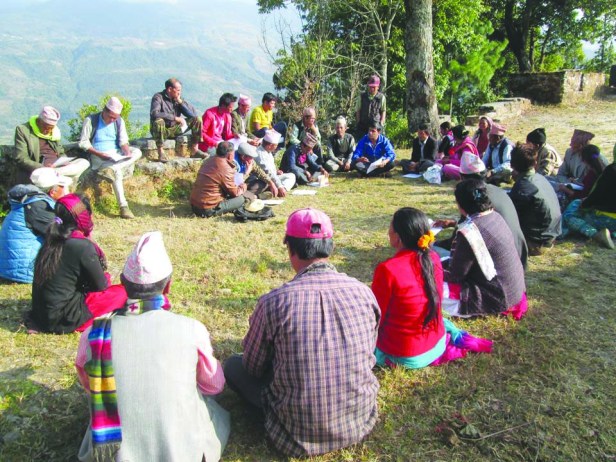
Community members discussing local development priorities in Okhaldhunga (Nepal). (C) 2015, Rakesh Karna
A. INTRODUCTION
The unification of Nepal was more of an annexation of smaller principalities and less of cultural amalgamation of the people living in those territories. Hinduism in general and Varna-based hegemony, in particular, guided the well-known dogma of King Prithvi Narayan Shah, a common garden, or Sajha Phulbari in Nepali. The Hindu social framework, based on four Varna, a Sanskrit word that denotes type, order or class, put Brahman (the priest) at the top, Kshatriya (the warrior) beneath them, followed by Vaishya (the merchant) at the third rank and Sudra (the untouchable or impure) at the lowermost position in the societal hierarchy. The Muluki Ain (Country Code), in 1854, constituted differential privileges, rights and duties to these higher, middle and lower caste groups. Although the caste-based hierarchy and discrimination was abolished in 1963 and anti-discrimination have been an integral part of last four constitutions, public institutions, social structures and the mainstream polity are still predisposed by the same dogmatism.
Since the restoration of democracy, in 1990, the minority and indigenous nationalities started venting their aspirations publicly. Continuity of ‘one language and one culture’ policy and ignorance from ‘democratic’ elites in post-1990 years drove the excluded groups and regions at the margin of a democratic system. When ruling parties were busy in ‘engineering’ market-centric liberal democracy in Kathmandu, the Maoists synchronised the insurgency tactics with the dispersed aspirations of identity, equality and self-determination. The aspirations were further consolidated through elevating the socially-excluded men and women in higher ranks of different political and military structures, recognising minority and indigenous history and literature in the cultural activities, declaring ethnic identity-based autonomous territories and finally asserting the exclusion agenda in the Comprehensive Peace Accord in 2006 and the In- terim Constitution, 2007.
The paper is divided into two parts. The first part focuses on the milieus of Nepalese social composition with focus on women, indigenous nationalities, Madheshi and Dalits. The second part scans the periodic policies in Nepal from minorities’ perspective. During 1956-2015, thirteen periodic plans have been applied in the country. The review circumnavigates the policies since 1991. In the end of this chapter, we conclude whether policies in Nepal are guided by the democratic aspirations of social justice, equitable distribution of resources and end of exclusion through the systemic socio-economic transformations.
B. DISCUSSION
1. Nepalese social groups
The national population, 26,494,504, represents 125 caste/ethnic, 123 linguistic, and 10 religious groups in addition to 2 percent of the national population with some kind of disability[1]. Only 18 caste/ethnic groups represent more than 1 percent of the national population each. 20 groups have a population between 230,000 and 100,000. Likewise, 15 have a population between 100,000 and 50,000 and 38 groups represent a population of 5,000-50,000 individually. More than 34 groups have populations less than 5,000 each. The largest caste group is Hill Chhetri who represents 16.6 percent of the national population. The second largest group is Hill Brahman (12.2%), followed by Magar (7.1%), Tharu (6.6%), Tamang (5.8%), Newar (5.0%), Kami (4.8%), Musalman or Muslim (4.4%), Yadav (4.0%), Rai (2.3%) and Gurung (1.9%) (CBS, 2011). Comparing the social groups of Nepalese pop- ulation, Hill Brahman/ Chhetris constitute 31.4 percent of the total population whereas Tarai/ Madhesh Brahman/Chhetris (TMBC) represent only 0.7 percent (CBS, 2011).
Although indigenous nationalities (IN) is the largest social groups repre- senting 35.7 percent of the total national population, the population is shared by Newar (5%), Hill IN (22.2%) and TM IN (8.5%). Officially, Dalits are 13 percent of the national population or 3,435,987 in number; Hill Dalits cover 65, and TM Dalits represent 35 percent. TM Other Castes (TMOC) share 14.2 percent, and Muslims cover 4.4 percent and remaining 0.7 percent of the national population is shared by other smaller and unidentified groups.
National Census 2011, correspondingly, enlisted Hinduism with the largest followers, 81.3 per- cent, followed by Buddhism (9%), Islam (4.4%), Kirat (3.1%), Christianity (1.4%), and Prakriti (0.5%) in addition to Bon, Jainism, Bahai and Sikhism (Table 1). It further records that out of the 123 languages spoken as mother tongue in Nepal, Nepali language has the largest percent- age of speakers, 44.6%, followed by Maithili (11.7%), Bhojpuri (6%), Tharu (5.8%), Tamang (5.1%), Newari (3.2%), Bajjika (3%), Magar (3%), Doteli (3%) and Urdu (2.6%). 1.9 percent of the total population has some kind of disability with 36.3 percent of persons with disability have physical disabilities. 65.9 percent of the total population are literate with 75.1 percent men and 57.4 percent women.
These impressive figures certainly put Nepal among the rank of diverse countries in the world. However, the socio-economic and political structures and practices, largely manifested by the notion of ‘Nepali nationality’ based on Hindu religion and Nepali language, had instituted various forms of discrimination and marginalisation. Those exclusive practices fostered handful number of social groups as ‘superior’ to the rest of the larger number of populations based on their non-dominant identities.
| Table 1: Caste/Ethnic, Linguistic and Religious Groups in Nepal | ||||||
|
SN |
Caste/Ethnic |
Population
(%) |
Linguistic |
Population
(%) |
Religious |
Population (%) |
| 1 | Hill Brahman/Chhetri* | 8,278,401 | Nepali | 11,826,953 | Hindu | 21,551,492 |
| (31.2) | (44.6) | (81.3) | ||||
| 2 | Tarai/Madhesh/ | 220,660 | Maithili | 3,092,530 | Buddhist | 2,396,099 |
| Brahman/Chhetri | (0.8) | (11.7) | (9.04) | |||
| 3 | Newar | 1,321,933 | Bhojpuri | 1,584,958 | Islam | 1,162,370 |
| (5.0) | (6) | (4.4) | ||||
| 4 | Tarai/Madhesh Other | 3,744,112 | Tharu | 1,529,875 | Kirant | 807,169 |
| Castes | (14.2) | (5.8) | (3.1) | |||
| 5 | Indigenous | 5,586,681 | Tamang | 1,353,311 | Christian | 375,699 |
| Nationalities (Mountain & Hill) | (21.1) | (5.1) | (1.4) | |||
| 6 | Indigenous | 2,261,781 | Newari | 846,557 | Prakriti | 121,982 |
| Nationalities (Tarai/ Madhesh) | (8.5) | (3.2) | (0.5) | |||
| 7 | Dalits (Hill) | 2,151,626 | Bajjika | 793,416 | Bon | 13,006 |
| (8.1) | (3) | (0.05) | ||||
| 8 | Dalits (Tarai/ | 1,181,495 | Magar | 788,530 | Jain | 3,214 |
| Madhesh) | (4.5) | (3) | (0.01) | |||
| 9 | Muslim | 1,164,255 | Doteli | 787,827 | Bahai | 1,283 |
| (4.4) | (3) | (0.005) | ||||
| 10 | Others | 107,129 | Urdu | 691,546 | Sikh | 609 |
| (0.4) | (2.6) | (0.002) | ||||
| (Source: CBS, 2011)
* The Constitution of Nepal, 2015 included Sanyasi and Thakuri with Hill Brahman and Chhetri and named them as Khas Arya. Inclusion of Thakuri and Sanyasi with Hill BC increases the latter’s popula- tion from 28.7 percent to 31.4 percent. ** Jain (other category, included in the 2001 Census) and Churaute (Muslim category, included in 1991 and 2001) have been excluded in the 2011 caste/ethnic groups. |
||||||
The process of unification and state building in Nepal resulted in ethnic stratification on unequal terms and the high-caste Hindus, residing in central hills, benefitted from the political power sharing with the rulers (Hangen, 2007). Hangen argues that those beneficial included Khas, living in the hill regions since as early as second millennium B.C., Thakuri, members of the landed gentry, and Hill Brahman, both of whom supposedly emigrated from India around the twelfth century. Nepali scholars contextualise the division of caste and ethnic groups[2] as ‘superior and inferior’ groups or ‘majority and minority’ (Hachhethu, 2003). Hachhethu further asserts that Nepali language and Hindu religion are deeply linked with the roots of Hill Brahmin and Chhetri; and their population, language and religion are in dominant position; 31.4, 44.6 and 81.3 percent respectively, in addition to their sway in the society and state. Moreover, so, the HBC are dominant, or majority group and rest of the populations are in the minority.
However, not all HBC share the same privileges of being at the top of social and political configurations. There is also a sizable number of them, in particular in the hills of Far and Mid- West development regions, who suffer from impoverishment. Also, the difference between Hill Brahman and Hill Chhetri is considerable in areas such as sharing development indicators and representation in state organs. The inconsistency between and within social groups is marked in all caste/ethnic groups in Nepal, which is explained in Chapter 4. However, this is largely a flaw of centralised and top-down governance system that upholds exclusion not just by caste, ethnicity, religion and language but also on geographical remoteness and deep-rooted culture of nepotism and corruption in the country.
Women
Women constitute over half of the national population in Nepal and have recently enjoyed some positive trends in the areas of maternal health, literacy, economic opportunities, and political representation. The affirmative policies and programmes of the government have been helping in gradual progress regarding women empowerment and their representation in decision making. Establishment of the Women and Children Office (WCO) in all 75 districts, formation of National Women’s Commission (NWC), adoption of Gender Responsive Budgeting (GRB), establishment of a gender unit in the Office of the Prime Minister and Cabinet of Ministers (OPM- CM), provision of a Gender Focal Point (GFP) in the sectoral ministries and support to integrate the Gender Equality and Social Inclusion (GESI) in government policies and programmes are some of the key developments towards gender equality in Nepal (Acharya, 2016).
Despite the notable improvement in the overall situations of women for last two decades, Nepalese women still face multiple layers of discrimination and exploitation. The challenges can be broadly divided into two categories; one that is based on gender and the other based on social exclusion. Gender-based discrimination has many forms. For instance, Nepal Demography and Health Survey (2011) shows that only 46 percent of married women participate in the decisions related to own health, major household purchases and even visits to family and relatives (MoHP, 2011). Only 30 percent of the employed women receive earning in cash or in-kind payment compared to 81 percent among the employed men. 61 percent of the women are not paid for their work at all. Having women’s individual ownership of assets ensures their economic empowerment and social protection. However, only 6 percent of the women age 15-49 own a house and 10 percent land alone.
One of the key factors that augment women’s vulnerability to gender-based violence is the dependency on men. For instance, the citizenship provision in Nepal does not allow a woman as a sovereign individual and her identity comes from the father. The child a woman born can only receive naturalised citizenship if the father of the child is not known or is a foreign national. The underlying social, economic, cultural and gender norms force many women to the absolute form of exploitation. For instance, the Badi community in the mid-West is forced to com- mercial sex work due to social and economic hardships and over a quarter of such women are young girls (GON, 2012). Chhaupadi is a social tradition among the Hindu wom- en in the western Nepal that force them to live outside of the house, mostly under a shed with inhuman conditions, during the menstruation period, that last at least four days. The disparity flows across many social, economic and political areas.
The Constituent Assembly 2008 enjoyed the highest number of women representations in Nepalese parliamentary history; having 33 percent out of 601 members. However, the women, mainly HBC, top many of political and constitutional appointments by their political connection. A study of Gender Development Index (GDI) and Gender Empowerment Measure (GEM) between 1996 and 2006 showed the growth of GDI and GEM in all three ecological regions in Nepal; Mountain, Hill and Tarai (Mishra, 2012) and found that the hill region had enjoyed unceasing higher GDI and GEM values from the year 2000 to 2006 comparing to the mountain and Tarai regions.
The identity, issue and needs of women population in Nepal vary across geography, caste, class and profession. In broader linguistic term, the gender issues in Nepal can be classified into two categories; Indo-Aryan and Tibeto-Burman. Women in the Indo-Aryan speaking groups suffer more from different treatments and subordination whereas the women in Tibeto-Burman speaking groups have fewer constraints regarding mobility, marriage, livelihood, and economic opportunities. Women from minority and indigenous groups have more predicaments than their counterparts in the dominant groups. Exposure to media, for example, varies across caste and ethnicity. 11 percent of hill/mountain women have access to the sources of media comparing to less than 2 percent among the Madheshi women (Bennett et. al., 2008). Poor access to radio, newspaper and television seriously affect women’s exposure to news and information creating barriers for basic health issues, political participation and even income opportunities.
Improvement in women’s access to employment opportunities is also not necessarily shared across the diverse women population. For instance, Dalit and Muslim women had almost no benefits from the combined group of professionals, technicians and associates in 2001, and the trend remains intact even in 2011 with the highest proportion of Hill/Tarai Brahmin/Chhetri and Newar, 31 percent and 11 percent consequently (Acharya, 2016: 120-121). The Ministry of Women, Children and Social Welfare (MoWCSW) and National Women Commission (NWC) are two crucial agencies in Nepal to protect and promote women’s rights and to mainstream women agenda across the government systems. However, both have overlooked or ‘largely failed’ in considering the needs and priorities of women from minority and marginalised groups (Bennett 2006).
The achievements regarding political rights and representation in decision making, however, do not spontaneously lead to social and economic empowerment. Indifference concerning the political, social and economic disparity across caste and ethnic groups fragments unified women agenda. Generalisation of women issue is one of the key challenges in formulating effective policies and programs. To remain inspired by the achievements so far, Nepalese woman leaders have to share the dividends with women from diverse social groups as well. Moreover, gender disparity is not just concerned with the women but with the whole of society. Consequently, any efforts of women empowerment and gender equality should be integrated into the broader frame- work of societal transformation with clear milestones as inherited characteristics.
Indigenous nationalities
In 2002, the National Foundation for Upliftment of Aadibasi/Janjati Act (HMG, 2002a) defined the indigenous nationalities as, “a tribe or community as mentioned in the Schedule having its own mother language and traditional rites and customs, distinct cultural identity, distinct social structure and written or unwritten history.” The Act enlists 59 indigenous nationalities (IN); 18 from the mountain, 24 from hill and 17 from Tarai ecological regions. However, indigenous experts claim that the definition does not meet the standards set by the experts (Bhattachan, 2012). They further argue that although all nationalities are not indigenous peoples, in practice, they all are classified as indigenous. Relatedly, in the latest attempt to refine the list, the government formed a taskforce to review the list of indigenous nationalities in 2010, and the task force submitted a recommendation to enlist 22 additional groups. The recommendations drew criticism from indigenous groups concerning the proposal of renaming existing groups. For instance, Rana Tharu was proposed to be separated from Tharu, and Kulung, Yamfu and Aathpahariya from Rais (Bhattachan, 2011). The government, however, did not implement the recommendations. The census in 2011 recorded 35.7 percent of the national population as indigenous nationalities (IN) which, many groups and experts claim as ‘inaccurate data’ as the number could be as high as 50 percent. By social, economic and cultural backgrounds, IN are categorised in 5 groups; advanced, disadvantaged, marginalised, highly marginalised, and endangered. The advanced groups consist of Newar and Thakali.
There are huge differences within the indigenous groups. Raute and Chepang, for instance, are nomads[3]; and a large number of recently abolished bonded-labors, Kamaiyas and Kamalari, were Tharus and despite their significant percentage in the national population (6.6%), they still lag behind in many of development indicators and national politics (Chhetri 2005; Guneratne 2010). Newars, with a complex caste hierarchy of 20 or more groups in Kathmandu valley, have been an integral part of the ruling arena (Gellner, 2005). They, Newars, mainly follow Hindu- ism and Buddhism and are traditionally divided into 6 caste categories with many similarities to typical Hindu caste system; priestly, high, middle/farmer, lower/service, impure but touchable and impure and untouchable. When the identity movements of IN heightened, an organisation of Hill Chhetri, claimed that they are also indigenous and so need to be enlisted in order to ‘pro- tect their identity and prevent discrimination against’ them (ICG, 2011). Similar to the diversity within IN population, development indicators, socio-economic status, geographic location, and political representation also vary. Nonetheless, despite the differences, IN commonly demands the recognition and respect for indigenous identity, culture, tradition, knowledge, group spe- cific proportional representation, education in mother tongue, access and control over natural resources. They also strive for autonomy and right to self-determination in addition to ethnic identity-based federalism.
Madheshi
Unlike indigenous nationalities, Dalits, or other social groups, Madheshi is not any specific caste or ethnic group. They reflect a broader diversity of social, linguistic and religious groups. Madheshis consist of Hindu castes, such as Maithil Brahman/ Chhetri and Dalits; indige- nous nationalities, such as Tharu; and religious groups such as Muslim[4]. In a broader term, Madheshis are the regionally organised, non-Nepali speaking caste and ethnic groups, residing mainly in Tarai[5] districts in the southern plains, and who share common languages and cultures and suffer discrimination and marginalisation due to their kinship across the border and non-hill looking appearance (Karna, 2009). Tarai represents geographic and administrative definition whereas Madhesh is a cultural connotation of the inhabitants. To better understand the identity politics of Madheshis and their issue, a brief recap of history can help.
During the 17th century, the modern-day Tarai was divided into various principalities and served as a natural defence line due to few population and hugely dense forest. After the unification, Tarai became the most exorbitant acquisition of Nepali rulers because of land revenues, royalty from timber exports, levies on pastures and export of elephants (Ojha, 1983). Ojha further revealed the strategic importance of Tarai in the fulfilment of Nepali rulers’ obligatory precondition for territorial expansion as the resources from Tarai helped finance the growing military expenses during 18th and early 19th centuries. In 1815, a treaty, known as Sugauli Treaty, was signed between British’s East India Company and Nepal to end second British invasion during Anglo-Nepalese War during 1814-1816. Nepal lost almost one-third of its territory but later received few areas back, currently in the western Tarai, as a ‘reward’ to help British suppression of the Indian freedom struggle in 1857, known as Sepoy Mutiny.
Since the early 1950s, the government ran a malaria control program supported by US government (WHO, 2010) and the state-sponsored resettlement programme, until the mid-1980s, encouraged migration from hills to Tarai in an attempt to congeal control over the agricultural and industrial region (Miklan, 2009). During 1964-1974 only, 77,700 ha. of land was distribut- ed under official resettlement plan whereas additional 237,600 ha. of forests were, furthermore, encroached by the incomers (Kansakar, 1985). Kansakar further reported that the spread of de- forestation during 1922-1977 reached almost 60 percent and the population in Tarai increased over 163 percent. Net migration from hills to Tarai continued and reached 6.4 times by 1981 (Gartaula & Niehof 2013). Since then, Tarai has become the liberal host of continued influx of migrants from hills in a quest for better living conditions, economic opportunities, political aspirations in addition to the relief from cold weather, which in recent years turns not so affable due to deforestation, desertification, flood, erosion and unplanned human settlements alongside the major river basins such as Koshi, Kamala, Bagmati, Narayani, and Seti (Acharya et al., 2008; Dixit et al., 2007; MoSTE, 2014; NEAU, 2015). In absence of well-versed policy and programmes to better integrate the incoming population with the receiving communities, Tarai is, eventually, turned into a hotspot for social, economic, and cultural differences susceptible to tranquil manoeuvring by the ruling elites, both in Kathmandu and locally.
Diversity within Madheshi population correlates with the varying level of empowerment and representation. The ‘unification’ of the state greatly wedged the social, cultural and economic configurations in Tarai and has produced multiple layers of difference and discrimination across Madheshi groups. Lately, some of the groups such as Tharus, Muslim and Dalits seek their distinct identity concurrently staging collective campaigns demanding identity, inclusion and fair share in the power[6]. However, the commonalities in issue bring the factions together, time and again, while staging the protest against the unified ruling elites.
The epistemic community has failed to clear blurry portray of Madheshis until 2007 when Madhesh Revolt vibrated the national and international communities to pay attention to their grievance (ICG, 2007). Although Madheshis’ demand[7] is not a neoteric incident, they certain- ly are one of the most flouted political itineraries in Nepal’s modern history. Discrimination, citizenship issues, access to public resources and opportunities in social and economic sectors are their age-old demands, and some of the issues exist since 1950s (Kumar, 2015). Madheshis are categorically striving for the end of ‘internal colonisation’, respect for their cultural and social identity, representation in proportion of their population, and power sharing through fed- eral governance system (Drucza, 2014; Gellner, 2007; Hachhethu et al., 2008; Shneiderman & Turin, 2012). It was the 2007’s Madhesh Revolt that, undoubtedly forced the state to recognise them as one of the key stakeholders should Nepal strive for inclusive, peaceful and stable dem- ocratic future (Lawoti, 2016; Pandey, 2013).
Dalits
The division of social groups into four Varnas; Brahman, Kshatriya, Vaisya and Sudra secured the highest seat to the Brahmans and the lowest to the Surdras. The division further arranged caste and sub-caste groups under each of the Varnas. Sudras were considered as the labour class and assigned the tasks of serving other three groups. They were not allowed to study Vedas or even hear the sacred chants. The lowest of the Sudras became ‘impure’ who were treated as
untouchable. Caste-based discrimination, including untouchability, was expanded during 14th century by King Jayasthili Malla to reshuffle Newar community in Kathmandu into 64 castes based on their occupation and this, with influence from Hindunisation and Sanskritisation, led to the emergence of Newari Dalits such as Pode, Chyame and Kusle at the bottom of the Newar caste hierarchy (UNDP, 2008). The Civil Code, or Muluki Ain, in 1854, further restructured the caste system into four broad categories declaring 18 castes as untouchable with bottom 10 as Dalits[8]. The Code was eliminated in 1963, but the social and cultural practices remained as an integral part of Nepalese society. The Code was further amended in 2006 widening the defi- nition of ‘crime’ that includes any forms of untouchability and discrimination based on caste, class or religion. In 2011, government enforced the Caste-based Discrimination and Untouchability (Offence and Punishment) Act, 2068 (AD), which considers untouchability and caste- based discrimination as criminal offence and violation of such law, in either public or private areas, results in punishment and penalties (GON, 2011a).
Dalits constitute 13.2 percent of the national population (CBS, 2011), which, for long is challenged by Dalit activists claiming that actual number above 20 percent. Discrimination in the census process and veiled surname of many Dalits are the biggest challenges behind Dalits’ reduced population (Darnal, 2005; ISDN, 2008). National Dalit Commission enlisted 26 sub- castes (7 hill and 19 Tarai/Madheshi) under Dalits, with Kami as the largest (4.8% of the total national population)[9]. Since Dalit is not a homogenous group, their population is divided, and heterogeneity extends to religion, language, and region. Based on these characteristics, Dalits in Nepal can be divided into the Hill, Newar and Terai. Occupation, geography and sex add additional layers to the intra-Dalit social dimension which excludes the issues Dalits face with non-Dalits (Kanaujiya, 2012; Lamsal, 2008; Anon, 2011).
Discrimination and untouchability are two major challenges Dalits have been facing even be- fore the unification of the country. Issues of Dalits can be better illustrated by social; such as caste-based discrimination, illiteracy, gender, citizenship and regional disparities, economic; such as the highest frequency of poverty, health; such as higher mortality rate and lower life expectancy, political; such as significant exclusion in the political spheres, and development; such as improvement in traditional skills and advancement of socio-economic conditions (Barr et al., 2007; Dahal et al., 2002; Khanal et al., 2012; Kharel, 2007). Similarly, there is also a need for appropriate legislation and policies, backed by wider advocacy campaigns to implement those policies, and a robust monitoring and review mechanisms (ILO, 2005). Scattered efforts, intra-group discrimination, donor-funded implicit projects, party-aligned movements, and lack of solidarity with other rights-based peaceful campaigns are weakening Dalits’ aspiration for equality. Like women, Dalits are also a part of the population, across all geographic regions, and they need a broader support base as standalone efforts may help to make uproars but do not assist them to secure the leadership.
2. National policy priorities and social inclusion
Nepal officially began periodic planning process in 1956. The First Five-Year Plan focused on national economy and the possibility for growth by concentrating on agriculture, irrigation, power, health, education in addition to land reform and resettlement (HMG, 1956). It could not be fully implemented as the parliament was dissolved in 1960. The next plan, 1962-1965, was introduced in the interim. The third and fourth plans, 1965-1970 and 1970-1975, increased the role of local Panchayat (HMG, 1965; HMG, 1970). Decentralisation was introduced, districts were divided into three groups based on the recommendations of Decentralization Commission, and development grants were allocated based on the number of village Panchayat within each district and geographic region. Although social and economic developments were included, poverty was integrated into the Fifth Plan, 1975 (HMG, 1975). Sixth and seventh plans continued the previous trends with more expenditure, and foreign aid was reaching 66 percent (HMG, 1980; HMG, 1985). The need for a woman-focused national policy was felt in the sixth plan and further defined in the seventh plan.
The People’s Movement-I, 1990, restored the multi-party democracy and election of Legislative Parliament was held in 1991. The government had to deal with the leftovers from Panchayat System, including public expenditure which increased from 7.6 percent of the Gross Domestic Product, or GDP, in 1974/75 to 11.5 percent in 1989/1990. In fact, it was just the beginning of heightening public expenditure which still continues. The growth in the per capita income was extraordinarily low, 0.8 percent during 1964/65- 1989/90 (HMG, 1992). Despite the slow growth rate, foreign aid and loans were on the rise which was later declared as ‘unproductive’[10]. Apart from the substantial burden of the past, it was an opening of a new horizon full of hopes.
The Eighth Five-Year Plan (1992-1997) introduced market-oriented liberal economy as the foundation for sustainable economic growth. Social justice was integrated into the decentralised development approach. Despite the high aspirations, among the minorities and indigenous nationalities, the Plan literally failed in recognising them beside the arrangements of some basic program for women, children, Raute¸Sarki and bonded-labours. The Eighth Plan, in a nutshell, was entirely focused on laying the foundation of market-centric liberal democracy. The Plan overlooked the need of a systematic institutional change to share democratic dividends with the wider population. Five years later, in 1997, a review recognised the lack of clear vision on decentralisation and an effective institutional mechanism for local development negatively impacting the development of backward areas and ethnic groups (HMG, 1997). The Review further highlighted political instability as one of the key challenges followed by governments’ weakness in good governance, the rule of law, public accountability and people’s participation. Not much was done despite the self-realisation and the Maoist Insurgency begun in 1996 citing inability of the system to serve the interests of its people.
The Ninth Five-Year Plan (1997-2002) adopted an aim of poverty reduction from 42 percent, in 1996, to 10 percent, by 2016/17 (HMG, 1997). 7.2 percentage of average annual growth of the GDP and 100 percent literacy rate was projected for the following two decades. The balance be- tween growth and equity were recognised as the basis for economic growth and sustainable development. Backward areas, disadvantaged and ‘ignored’ groups were primarily targeted. This was the first time when the state officially confessed the marginalisation of excluded groups from national policy system. Celebrating King Birendra’s 26th year of the reign, the elected parliament enacted Local Self-Governance Act in 1999 (HMG, 1999). The Act still serves as one of the key legal documents for laying out exclude groups’ participation in local development.
During the Ninth Plan, some significant developments occurred; Kamaiyas (bonded-labour) were freed, and National Academy for Indigenous Peoples, National Women Commission and National Dalit Commission were established. However, the insurgency jeopardised the implementation of ninth plan leading to the diversion of development budget to security forces. The GDP growth limited to 3.6 percent, the population below poverty line remained 38 percent against the set target of 6 percent for the GDP and 32 percent decline in the poverty incidence. Regular expenditure increased to 9.3 percent, in annual average, mainly because of the increase in salary and other expenses of the government officials and security forces (HMG, 2002b).
The Tenth Five-Year Plan (2002-2007) continued focusing on poverty alleviation but adopted Poverty Reduction Strategy Papers (PRSP). Social exclusion was identified as one of the three key aspects of poverty besides income-based poverty and human development. Poverty and HDI were considered effective tools to mitigate poverty among the excluded communities. The Plan also highlighted the primary role of state in the empowerment of Dalits, indigenous nationalities, ‘blind and disabled’, and recognised women as the ‘focal point’ of development.
Between 1990 and 2006, 14 prime ministers ruled the country, in addition to the king’s direct rule in 2002 and 2005. The People’s Movement-II, during the first quarter of 2006, changed the political landscape. The parliament restored, republic replaced monarchy, and the prior system and policies were held primarily responsible for the exclusion of minority, indigenous nationalities and other socially excluded groups and regions. The following sections look closely at the national planning processes in the post-monarchy era whether ‘new’ policy planning has learned from past mistakes of side-lining the minorities.
Three-Year Interim Plan (2007/08-2009/10)
‘New Nepal’ inherited a country devastated by decade long armed conflict: two armies; thou- sands of families with someone killed, disappeared and displaced; and mounting public expectations for reform in the public institutions. Meanwhile, the poverty rate declined at 31 percent (with income inequality, Gini coefficient, increased from 0.34 to 0.41) and Nepal ranked at the 138th position of the HDI, the lowest position in South Asia (GON, 2008a).
Although the previous plans had attempted to focus on women, indigenous nationalities, Dalits and other excluded regions, Madheshi, for the first time in Nepal’s periodic planning history, was recognised as a priority group. The Three-Year Interim Plan (TIP) aimed at laying the foundation for a ‘Modern, Prosperous and Just Nepal’ by establishing peace and reducing un- employment, poverty and inequality (GON, 2008a). The TIP 2007 is considered a breakthrough regarding inclusive planning process in Nepal. Although the LSGA (HMG, 1999) laid the foundation for participatory development planning process, the term ‘participatory’ remained vague and contingent at the ‘discretion’ of political leadership, policy planners and development administrators. Discretionary development planning and implementation process favoured some and excluded others, and that fact is evident in the poverty incidences, income inequalities and disparities within caste and ethnic groups (next chapter reviews the development indicators and disparity across regions and groups).
The TIP adopted 6 strategies with priority to the economic well-being of the women, Dalits, indigenous nationalities, and Madheshi among others. A separate chapter on Social Justice and Inclusion was integrated recalling the national commitments to over twenty international treaties and instruments (GON, 2008b). The Chapter, on Social Inclusion, highlighted the plights of minority and indigenous groups and thus adopted a long-term vision of ‘building an Inclusive…’ Nepal. The TIP 2007 set progress measurement targets for the excluded groups as well with 10 percent increase in the Human Development Index (HDI), 10 percent increase in the Human Empowerment Index (HEI) of the excluded groups and 10 percent increase in the Gender Empowerment Index (GEI) for the excluded women. Further arrangements were integrated to guide the state in ensuring gender equality and social inclusion of the excluded groups. Mainstreaming of the excluded groups in all parts of development processes and outcomes, proportional representation in all decision-making bodies, provision of special programs, policy discrimination in favour of the excluded groups were remarkable policy provisions.
A mid-term review witnessed the decline in poverty incidence, at 25 percent, but an increase in the income inequality, Gini Coefficient (increased to 0.46 from 0.41) (GON, 2011b). Nepal remained at 138th position of the HDI in the world. Economic growth remained at 4.5 percent against the 5.5 percent target. Various identity movements, CA-I Election, and the emergence of pro-reform forces (e.g. Maoist and Madheshi parties) were perceived as the obstacles in full realisation of the TIP 2007. Theoretically, the entire plan was based on rights-based approach to poverty reduction with a focus on inclusive development. It was practically a technocratic framework that attempted to accommodate political aspirations in quantifiable indicators. Despite the shortcomings, nevertheless, the TIP 2007 ‘embraced’ inclusion as the core of socioeconomic development with due political participation of the excluded groups.
Three-Year Interim Plan (2010/11-2012/13)
The Interim Plan (2010/11-2012/13), or TIP 2010 further elaborated the concept of gender and inclusion. The approach of Gender Equality and Social Inclusion (GESI) was elaborated and group specific sections for women, Dalits, Madheshi, indigenous nationalities, persons with disability (PWD) were defined. It laid out the detailed plan for each of the groups. In addition to the above group specific measures, the TIP 2011 also elucidated the need for a ‘balanced development’ to bridge the disparities across different ecological and administrative regions. Since poverty alleviation had remained the core of periodic plan for long, the TIP 2010 added further measures to deal with poverty inside the minority and excluded groups (GON, 2011c). Inclusion was integrated as an effective tool to reach the excluded groups. However, lack of disaggregated data and empirical knowledge were recognised (and still is) as a major hurdle to design and implement effective policy programs targeting the excluded groups and regions.
Three-Year Interim Plan (2013/14-2015/16)
Political uncertainty crippled the state institutions. Five governments, led by CPN (United-Maoists), Nepali Congress and CPN (UML), failed to manage the diverse interests into the constitution-writing process since 2008. The CA dissolved in May 2012 and a technocratic government, led by the (then) head of the Supreme Court, held the second round of CA election in November 2013. In the absence of clear roadmap, the conventional economic growth agenda re-emerged as the core of new interim plan, 2013-2015. As usual, past governments were accused of the failure of achieving stipulated indicators. Despite the reduction in poverty population, income inequality was still a significant threat to poverty reduction. For example, only 24.4 percent of the people living below the poverty line had access to primary education, and less than 16 per- cent of the poor had access to public health facilities (GON, 2013a). The new government, led by NC, endorsed the Plan for 2013-2015, taking a major shift from political empowerment and inclusive development of the excluded groups to ‘graduating’ from the list of Least Developed Countries (LDC) to the Middle-Income Countries (MIC) by 2022.
A new goal for poverty reduction was set; reduction to 18 percent and 6 percent of annual growth rate. Despite inclusive development remaining one of the strategies, group specific sections or provisions were removed in the plan. NGOs were expected to help the government in mainstreaming excluded groups (GON, 2013b). Despite the limitations regarding intra and inter-groups differences, the Plan mixed all groups together and set ambitious targets. A brief plan of state restructuring was proposed to ensure a ‘balanced development’ approach.
During the TIP 2013 period, the poverty declined to 21.6 percent (against the 18 percent target), and the GDP growth rate remained at 2.9 percent (3.1% less than set target). Evaluating the result of positive measures, the women representation in the legislative, executive and judiciary reached at 29.9, 17.5 and 3.0 percent (GON, 2016). Similarly, gender-responsive budget (GRB) reached at 22.3. However, the government failed to measure any development concerning other socially excluded groups.
C. CONCLUSIONS
The periodic plan, in principle, provides a broader framework with a clear direction to utilise the potential of a country. It is also a reflection of the state priorities and plans for the better future. Nepal planned, implemented and reviewed 13 periodic plans during 1956 to 2015. Each plan had some special features. The First (1956-1960) and Second (1960-1965) plans caught in the fight between the palace and political parties. The Third (1965-1970) and Fourth (1970- 1975) instituted the role of Panchayat System. Although decentralisation was endorsed in the meantime, it was in 1999 when the LSGA was enacted. Poverty alleviation was the gift of Fifth (1975-1980) plan which sustained in the Sixth (1981-1985) and Seventh (1985-1990) plans as well. Women agenda was recognised in the sixth plan and elaborated further in the seventh plan which witnessed the climax of Panchayat era.
The Eighth (1992-1997) plan was the first after the reinstatement of multi-party parliamentary democracy. It laid out the basics of development for backward regions and communities but predominantly focused on laying the foundation of the market-centric liberal democracy. The Ninth (1997-2002) plan continued on poverty-locus despite the early warning of bloody war fuelled by rising inequality across caste/ethnicity and regions. The government tried to address the grievances, by adopting poverty reduction strategy paper (PRSP) in the Tenth (2002-2007) plan.
The Eleventh (2007-2010) plan was built on the success of People’s Movement-II, People’s War and identity movements such as the Madhesh Revolt. Issues of minority, indigenous and other socially excluded groups were recognised and integrated into the plan. It attempted to create a ‘roadmap’ for inclusive transformation. Group-specific strategies, programmes and measures were codified in the Twelfth Plan (2010-2013). Growing frustrations, primarily over identity-based power sharing demands, failure of first CA and the election of the second one, resulted in the revival of ‘old-school’ agenda back in Thirteenth (2013-2015) plan. While inclusive and ‘balanced’ development remained on the list of priorities, the nub of the Plan was to graduate from least development countries list.
Issue of minority and indigenous groups has gained wider recognition in the post-1990’s constitutions and laws, but national policies are still searching for appropriate strategies that can ensure an inclusive and ‘balanced development’. Some positive indicators are achieved regard- ing health, education, infrastructure, connectivity and income prospects. However, the rising inequality in opportunity, resources and development achievements need more robust planning and accountable institutions. Achieving equality through poverty reduction may sound appeal- ing, but the biggest gap in the poverty reduction-focused planning process is that it seeks to pro- mote social inclusion through anti-poverty policy. The anti-poverty policy focuses on poor and excluded groups rather than the preconditions and institutions that manifest poverty or new pat- terns of exclusion. Without challenging the exclusionary norms and structures, absolute poverty may decline but relative poverty will remain as a key determinant of inequality and unrest. A question remains unresolved. Is Nepal able to realise the inclusive agenda through ‘old-school’ and exclusionary public institution? Another important area for further research.
[1] Detail report of the National Population and Housing Census, 2011, can be downloaded at http://cbs.gov.np/sectoral_statistics/population/national_report (16/04/2016)
[2] The caste groups, Jat in Nepal, are Caucasoid Hindus who speak Indo-European languages such as Nepali, Maithili and Bhojpuri. The indigenous ethnic groups, Janjati or Jati in Nepal, are Mongoloid, primarily practice non-Hindu religions and speak Tibeto-Burman languages such as Gurung, Tamang and Magar.
[3] See more information about the endangered and highly marginalized indigenous nationalities at http://www.un.org.np/oneun/undaf/endangered (10/12/2015).
[4] See Ansari, T.A. (1988) and Siddique, M. (2001) for details on Muslim in Nepal.
[5] The term ‘Madhesh’ is also used in lieu of Terai/Tarai. Generally speaking, Terai/Tarai denotes one of the ecological regions in Nepal alongside the hill and mountain whereas Madhesh reflects the social and cultural aspects of the people who primarily live in Terai/Tarai but differ from those with origin in hill/mountain and speak Nepali as mother language. Recently, the use of Madhesh/Tarai is commonly practiced to reflect the residents of Tarai including hill-origin and migrated people. For detail background on Tarai/Madhesh, see Sah’s Social Inclusion of Madheshi Community in Nation Building (2007) and Pathak & Upreti’s Tarai-Madhes: Searching for Identity Based Security (2009).
[6] The differences within Madheshi groups were not notably highlighted at the national level until the Madhesh Revolt in early 2007 and rise of Madheshi in the first CA Election in 2008 as fourth largest political force which remained influential in national parliamentary politics before the promulgation of new constitution in September 2015. For last 8 years, Madhesh-based parties have split in multiple factions shattering their bargaining capacity. Recent demonstrations and strikes, mainly in Terai, demanding their issues in the new constitution through amendment, have helped them regaining the ‘influence’ in national political sphere but it may be early to conclude the result of this ‘influence.’ In addition to the national and regional politics of ‘divide and conquer’, there are also genuine stimulus for the urge to seek distinct identity than Madheshi. Since 1990s, due to various movements, state allocated few affirmative measures targeting the minority and indigenous nationalities, including Madheshi, which lack efficient mechanism in terms of ‘fair’ distribution of the opportunities.
[7] See the evolution and dynamics of Nepali state formation and how it had triggered the exclusion of Madheshi in Gaige’s Regionalism and National Unity in Nepal (1975).
[8] In Sanskrit, the word Dalit literally means ‘oppressed.’
[9] See the list at http://www.ndc.gov.np/site/cms/4 (14/09/2015)
[10] In 1972/73, the foreign assistance had 37.4 percent of contribution in the total development expenditure, which increased to 61.1 percent in 1989/1990. However, the increase in the foreign aid also contributed in increasing burden on Nepal as the 20.8 percent of the total foreign loan in 1972/73 rose to 75.1 percent in 1989/1990. The government concluded that the actual utilisation of the foreign loan was considerably low despite the increase in the volume; the growth in the debt obligation of 2 percent in 1972/73 increased to 42.9 per cent of GDP in 1989/1990 (HMG, 1992). The government’s inability to use the foreign aid towards development priorities and in a coordinated manner were recognised as major challenges for the country.
References
Acharya, K.P., Poudel, B.S. & Dangi, R.B., 2008. State of land degradation and rehabilitation efforts in Nepal D. K. Lee, ed. IUFRO World Series, 20(III), pp.163–173.
Acharya, M., 2016. Progress of Women in Nepal (1995 -2015): Substantive Equality; non-negotiable 1st ed., Bharatpur, Kathmandu: Sahavagi.
Anon, 2011. Opening the Door to Equality: Access to Justice for Dalits in Nepal, Kathmandu.
Ansari, T.A., 1988. The Muslim minority in Nepal: a socio-historical perspective. Institute of Muslim Minority Affairs. Journal, 9(1), pp.161–163.
Barr, E. et al., 2007. Dalits in India and Nepal: Policy Options for Improving Social Inclusion in Education, New York, pp. 37-38.
Bennett, L., 2006. Unequal Citizens: Gender, Caste and Exclusion in Nepal (Summary), Kathmandu: The World Bank and DFID Nepal, pp. 18-19.
Bhattachan, K.B., 2012. Country Technical Note on Indigenous People’s Issues: Federal Democratic Republic of Nepal., pp.1–2.
CBS, 2011. National Population and Housing Census 2011: Social Characteristics Tables, 5(II). Kathmandu.
Chhetri, R.B., 2005. The Plight of the Tharu Kamaiyas in Nepal: A review of the social, economic and political facets. In R. B. Chhetri, K. B. Bhattachan, & B. Pokharel, eds. Occasional Papers in Sociology and Anthropology. Kathmandu: CDSA, Tribhuvan University, pp. 22–46.
Dahal, D.R. et al., 2002. National Dalit Strategy Report: Part-I- Situational Analysis of Dalits in Nepal, Kathmandu, pp. 62-65.
Darnal, S., 2005. Dalits of Nepal., pp.1–2.
Dixit, A. et al., 2007. Flood disaster Impact and Responses in Nepal Tarai’s Marginalized Basins, Kathmandu, pp. 124-128.
Drucza, K., 2014. A Garden of Different Flowers: Recognition and Representation in Nepal’s Social Inclusion Agenda. In New Opportunities and Impasses: Theorizing and Experiencing Politics in Politsci’ 13 Political Science Conference. Istanbul: Eastern Mediterranean Academic Research Center, pp. 56–61.
Gartaula, H. & Niehof, A., 2013. Migration to and from the Nepal terai: shifting movements and motives. The South Asianist, 2(2), pp.33–34.
Gellner, D., 2005. Ethnic Rights and Politics in Nepal. Himalayan Journal of Sociology and Anthropology, 2, pp.5–8.
Gellner, D., 2007. Democracy in Nepal: Four Models. Seminar 576, pp.54–56.
GON, 2008a. Three Year Interim Plan (2007/08-2009/10), Kathmandu.
GON, 2008b. Social Justice and Inclusion. In Three-Year Interim Plan (2007/8-2009/10). Kathmandu: National Planning Commission, pp. 74–93.
GON, 2011a. Caste Based Discrimination and Untouchability (Offence and Punishment) Act, 2068, Nepal: Nepal Law Commission.
GON, 2011b. Review of the Three-Year Interim Plan (2007/08-2009/10). In Three-Year Interim Plan (2010/11-2012/13). Kathmandu: National Planning commission, pp. 2–5.
GON, 2011c. Peace, Rehabilitation and Inclusive Development. In Three-Year Interim Plan (2010/11- 2012/13). Kathmandu: National Planning commission, pp. 260–290.
GON, 2012. A Study on Gender-Based Violence Conducted in Selected Rural Districts of Nepal, Kathmandu.
GON, 2013a. Review of Three-Year Plan (2010/11-2012/13)., pp.1–3.
GON, 2013b. Three-Year Interim Plan (2013/14-2015/16), Nepal. Kathmandu: National Planning Commission.
GON, 2016. Review of Three-Year Plan (2013/2014-2015/2016). In Three-Year Interim Plan (2016/17- 2018/19). Kathmandu: National Planning Commission, pp. 1–19.
Guneratne, A., 2010. Tharu-State Relations in Nepal and India. Himalaya, the Journal of the Association for Nepal and Himalayan Studies, 29(1), pp.19–27.
Hachhethu, K., 2003. The Question of Inclusion and Exclusion in Nepal: Interface Between State and Ethnicity. In The agenda of transformation: inclusion in Nepali democracy, 24-26 April 2003, Kathmandu. pp. 1–22.
Hachhethu, K., Kumar, S. & Subedi, J., 2008. Nepal in Transition: A Study on the State of Democracy, Stockholm, pp. 94-96.
Hangen, S., 2007. Creating a “New Nepal”: The Ethnic Dimension. Policy Studies 24, pp.5–8.
HMG, 1956. Five-Year Plan 1956-1961, Kathmandu.
HMG, 1965. Third Five-Year Plan (1965-1970), Kathmandu.
HMG, 1970. Fourth Five-Year Plan (1970-1975), Kathmandu.
HMG, 1975. Fifth Five-Year Plan (1975-1980), Kathmandu.
HMG, 1980. Sixth Tenth-Year Plan (1980-1985), Kathmandu.
HMG, 1985. Seventh Five-Year Plan (1985-1990), Kathmandu.
HMG, 1992. Eighth Five-Year Plan (1992-1997), Kathmandu.
HMG, 1997. Ninth Five-Year Plan (1997-2002), Kathmandu.
HMG, 1999. Local Self Governance Act, 2055, Nepal.
HMG, 2002a. National Foundation for Upliftment of Aadibasi / Janjati Act, 2058, Nepal: Nepal Law Commission.
HMG, 2002b. Tenth Five-Year Plan (2002-2007), Kathmandu.
ICG, 2007. Nepal’s Troubled Tarai, Kathmandu, Brussels. Available at: https://d2071andvip0wj.cloudfront.net/136-nepal-s-troubled-tarai-region.pdf.
ICG, 2011. Nepal: Identity Politics and Federalism, Kathmandu, Brussels.
ILO, 2005. Dalits and Labour in Nepal: Discrimination and Forced Labour, Kathmandu: ILO Country Office for Nepal, pp. 71-72.
ISDN, 2008. The Dalits of Nepal: Acting for Change, p.4.
Kanaujiya, R.K., 2012. Structural Inequality between Madhesi Dalits and non-Dalits, Kathmandu, pp. 51-53.
Kansakar, V.B.S., 1985. Land Resettlement Policy as a Population Distribution Strategy in Nepal. In L. A. Kosinski & K. M. Elahi, eds. Population Redistribution and Development in South Asia. Dordrecht: Reidel, pp. 111–122.
Karna, R.R., 2009. Nepalese Minority Groups: Struggle for Identity and Representation, Kathmandu: Support Nepal, pp. 11-62.
Khanal, K., Gelpke, F.S. & Pyakurel, U.P., 2012. Dalit Representation in National Politics of Nepal, Lalitpur: NNDSWO.
Kharel, S., 2007. The Struggle for Full Citizenship for Dalits in Nepal: Approaches and Strategies of Dalit Activists. Himalaya, the Journal of the Association for Nepal and Himalayan Studies, 27(1), pp. 56–57.
Kumar, A., 2015. Nepal: The Politics of Constitution Drafting. Indian Council of World Affairs, p.4.
Lamsal, H.B., 2008. A Comparative Study on Intra-Dalit Untouchability, Kathmandu, pp.6-7.
Lawoti. M., 2016. Constitution and conflict: Mono-ethnic federalism in poly-ethnic Nepal. In V. Sachdeva, Q. Pradhan, & A. Venugopalan, eds. Identity Assertions and Conflicts in South Asia. New Delhi: Routledge, pp. 10-18.
Miklan, J., 2009. Nepal’s Terai: Constructing an Ethnic Conflict. PRIO South East Asia Briefing, 1, pp.3–4.
Mishra, M.K., 2012. A Comparative Analysis of Gender Related Development Index and Gender Empowerment Measures of Nepal (With reference to NHDR 1996 to 2009). Global Journal of Human-Social Science Research, 12(7), pp.38–39.
MoHP, 2011. Nepal Demographic and Health Survey 2011, Kathmandu, Maryland: Ministry of Health and Population, Nepal, New Era, ICF International, pp. 163-171.
MoSTE, 2014. Economic Impact Assessment of Climate Change in Key Sectors in Nepal, Kathmandu, pp. 2-18.
NEAU, 2015. Landslides and Flash Floods in the Monsoon, Kathmandu, pp. 1-9.
Ojha, D.P., 1983. History of Land Settlement in Nepal Tarai. CNAS Journal, 11(1), pp.21–22.
Pandey, N.N., 2013. Post 2006 Nepal: An Objective Overview. SEARCCT’s Selection of Articles, 1, pp.36–37.
Shneiderman, S. & Turin, M., 2012. Nepal and Bhutan in 2011 Cautious Optimism. Asian Survey, 52(1), pp.141–142.
Siddique, M., 2001. Muslim Population in the Kingdom of Nepal: Some Outstanding Features. Journal of Muslim Minority Affairs, 21(2), pp.333–334.
UNDP, 2008. The Dalits of Nepal and a New Constitution, Kathmandu, pp.19-22.
WHO, 2010. Nepal Malaria Programme Review. New Delhi, pp.10-11.
 Rakesh Karna