
Introduction
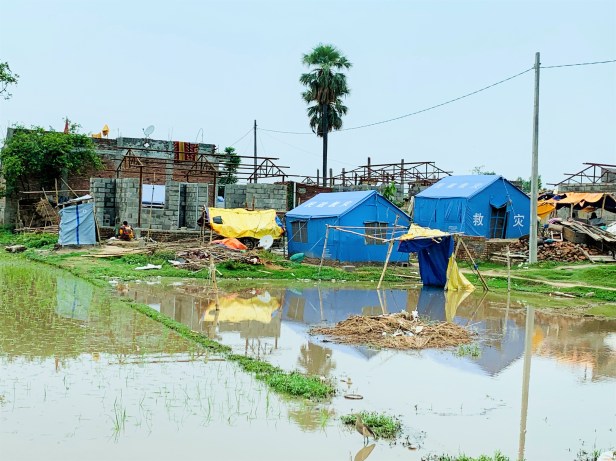
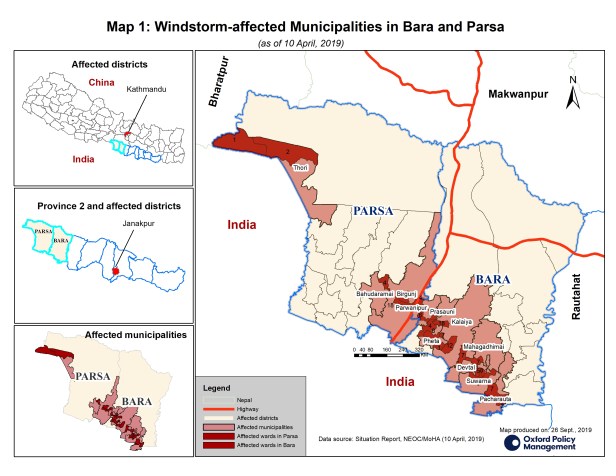
Nepal is one of the most disaster-prone countries in the world, having 80 per cent of its total population at risk from natural hazards including earthquakes, landslides, fires and hailstorms[1]. In the latest series of disasters, on 31st March 2019 some villages in Bara and Parsa districts in Province 2 were hit by a windstorm. The windstorm (with a width of around 200 meters and a length of 30 kilometres[2]) created havoc in the affected districts. The windstorm was known as Sundi[3] locally and was later called a tornado by government agencies in Kathmandu[4]. Altogether 21 wards in 11 rural and urban municipalities were affected, and the death toll reached at least 28 with over 668 people injured, as of 10th April 2019 (MoHA, 2019)[5]. According to assessments, 2,011 families were affected, about 12,000 people needed assistance[6], and critically, the affected areas faced the risks of disease outbreak[7].
Federal, provincial, district and local level leaders and agencies began their efforts in delivering rescue and relief materials by using various means, such as mobilising their own party cadres, local administrative and security apparatuses, and even direct distribution of relief materials by their leaders in certain affected areas. The need for robust disaster risk reduction and management surfaced due to the lack of preparedness, the habit of utilising disasters for vested interests, the overlap of institutional efforts[8], the duplication of relief distribution[9], and the lack of coordination between the levels of governments.
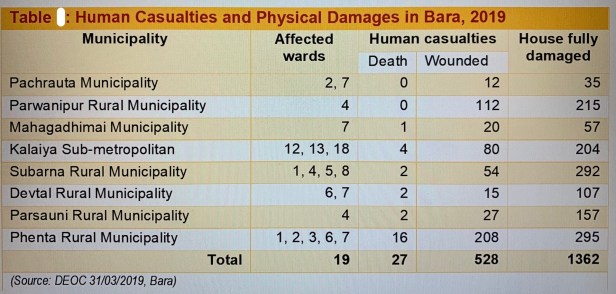
Over two dozen casualties and hundreds of wounded were admitted to nearby health facilities. While the windstorm struck both districts, Bara experienced the worst in terms of human casualties and damage to properties in addition to livestock. While one person died in Parsa, the death toll reached 27 in Bara with over 500 wounded (Table below). Phenta Rural Municipality was the most affected, with almost 60 per cent of death and 40 per cent of the total number of wounded in the district. While Kalaiya Sub-metropolitan follows Phenta in human loss, Parwanipur witnessed the second-largest number of injured, and Subarna suffered from the most damage to physical properties.
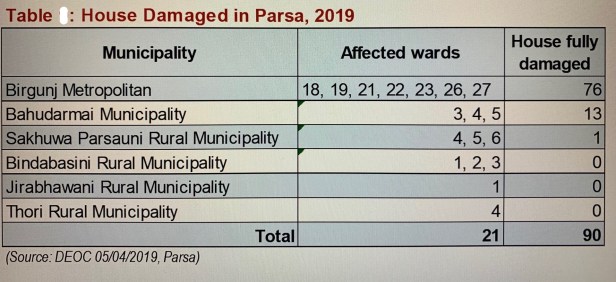
On the other hand, 90 houses in 21 wards across six municipalities in Parsa were destroyed during the windstorm (Table below). The preliminary assessments show damages worth NPR 273 million (NEOC, 10/ 04/201; DEOC/Bara, 25/06/2019).
Coordinating agencies and actions after the windstorm
Often the response in the wake of disasters draws attention rather than the necessity for better preparedness[10]. Not just federal but also province, district and local level agencies lack sound and harmonised plans for preparedness and response. Given that a windstorm of this magnitude had not hit Nepal for several decades, the preparedness plan did not receive adequate attention until 31st of March 2019. As soon as the next day, a ‘race’ between federal, provincial and local levels was on in terms of (1) who visits the affected communities and how many times, (2) who announces the most attractive compensation and support packages, (3) who coordinates with federal level senior leaders, and (4) who distributes the relief, inaugurates reconstruction projects, and draws crowds at public meetings.
Soon after the storm struck, neighbouring local communities, social groups, elected representatives and security personnel from nearby posts were the first to respond. The district authorities (primarily the CDO) were reported to coordinate the efforts within a few hours of the incident. The initial response focused on the search and rescue of victims, opening the interrupted road to and from affected communities, bringing injured persons to hospital, and ensuring safety and protection to Sundi affected people.
While most of the local levels agencies, especially their elected representatives, became busy providing helping hands (e.g. guiding security personnel in locating and rescuing victims and providing food supplies to the most affected), the district authority began coordinating with humanitarian agencies, NGOs, private sectors and in/formal groups to reach out to the most in need. Although the DAOs in both districts were frequently coordinating with federal and local levels, the interaction between the DAO and the province was not often proactive and organised but ‘on demand’. The provincial government was quicker than the federal government to reach the affected areas; both levels competed to be seen as ‘closer’ to the affected areas. Opinion is divided as to whether the initial visits by provincial and federal leaders brought any tangible relief to the victims and those engaged in the rescue and relief operations other the announcement of forthcoming lucrative relief packages. Nonetheless, their visits monopolised the time and attention of local and district level agencies, who had to manage security and organise interaction with the victims for them.
On 1st of April, 2019, the government of Province Two formed a high-level committee, the High-level Rescue and Relief Management Committee (HRRMC), to assess and provide rescue and relief to the affected areas of Bara and Parsa. Led by the Minister of Internal Affairs and Law (MoIAL), the HRRMC, on 2nd of April 2019, decided to build prefab homes for people who had their houses destroyed and formed a Help Desk to manage the rescue and relief distribution to the affected communities. The Help Desk, led by the State Minister of the MoIAL, included two more state ministers, the CDO and security chief of the respective districts, and one representative from the local level and an NGO/s representative.
On 4th of April 2019, the OPMCM issued a cabinet decision to federal ministries (Defence and Urban development) that the Government of Nepal (meaning the federal government in this case) would build the houses of affected households with the help of the Nepal Army (NA).A coordination and facilitation committee, led by the Chief Secretary of Province Two and members including representatives from the Ministry of Urban Development, the NA, and the Chief District Officer (CDO) from Bara and Parsa districts, was also formed. On the following day, 5th of April 2019, a meeting of the Executive Committee (EC), led by the Home Minister of the federal government, decided that a ‘one-door system’ was to be adopted for relief and service distribution in the affected areas in Bara and Parsa[11] (MoHA, 05/04/2019). The DAOs in respective districts were assigned to lead this distribution system and had to coordinate with respective local governments.
To minimise future risk and damages from disaster, the EC also asserted the need for a robust plan addressing the issue of preparedness and cooperation between relevant ministries/departments, humanitarian agencies, and private sector organisations. To smooth communication among national, provincial, district and local levels during a disaster, an operational standard on emergency communications system was also approved and issued by the EC[12]. The standard establishes a radio communication system among the NEOC, security forces, the PEOC and the DEOC. It also facilitates communication with the LEOC and the UN Emergency Coordination Centre.
Further to these executive decisions in the aftermath of the windstorm, an NDRRMC meeting, chaired by the Prime Minister, was held 5th of May 2019. The meeting directed the EC, the Provincial Disaster Management Executive Committee (PDMEC), District Disaster Management Committees (DDMC), Local Disaster Management Committees (LDMC) and other relevant organisations to play a ‘more effective’ role in DRR, preparedness and response, relief and rehabilitation. Other significant decisions of the Council were as follows:
- MoHA to prepare a legal draft to draw the lines of authority, responsibility and accountability between federal, province and local level on the basis of the nature, intensity, and impact of the disaster in Nepal;
- MoHA to draft an umbrella law to avoid duplication in the mobilisation of disaster management funds at various levels and relief distribution;
- Enforce the application of Disaster Management Information System (DMIS), coordinated by MoHA, at all levels and exchange information about activities and other related information; and
- Direct province and local levels to formulate and implement policy and strategic action plan in line with national policy and strategic action plans.
There was no consistency in terms of how local municipalities responded to the disaster. Some local municipalities cooperated with local police posts for rescue operations and mobilised local vehicles for transporting the wounded to nearby health facilities, whereas some were extremely reliant on district authorities, local groups and humanitarian agencies in rescue efforts and relief distribution. The level of coordination was relative to the individual skill and experience of elected representatives, i.e. mayor of municipality and chair of the rural municipality. Respective local levels also made decisions in terms of (1) providing immediate rescue, relief and shelter as well as treatment facilities, (2) announcing compensation and relief packages, and (3) coordinating with district, provincial and federal governments (but primarily through their personal and political network) to channel relief and other support.
Individuals, local groups, business communities, neighbouring municipalities, relatives and friends of the victims (from India and other countries), humanitarian agencies and even political parties offered their help, e.g. medicine, food, shelter and cash. While the level of coordination in Parsa was acceptable, Bara suffered from an utter lack of inter-agency coordination. This was mainly for three reasons: (1) Parsa suffered from significantly less human casualties and had limited areas affected by the windstorm; (2) Bara has more remote areas making it difficult operationally to reach and support; and (3) Birgunj/ Parsa being the first point of entry to many affected areas in Bara, the district authority in Parsa utilised this opportunity to coordinate with provincial and federal agencies first. In addition, the diverse interests of local elected leaders and the high concentration of provincial and federal level senior leaders consumed most of attention of district authority agencies in Bara, who were already suffering from a lack of capacity to respond.
Political interests and incentives of disaster response
Politically speaking, based on historic precedent in Nepal, disaster response offers a unique opportunity to those in power to showcase their strength. For example, the ruling political parties and senior bureaucracy have always had the chance to focus on preparedness and response to avoid or minimise disaster risks. On the other hand, the opposition political parties can always demand better preparedness and response plans in addition to helping the government effectively implement DRRM related policy strategies.
A coordinated approach is not just rewarding in terms of responding to disasters but also in saving lives and managing scarce resources, including public funds. Often, coordination and collaboration are purposely poor to enable inadequate scrutiny and mismanagement of public funds. Coordination and cooperation among agencies require transparency and accountability. If not transparently managed allocated resources may be used for vested interest such as ‘buying’ public sentiment, mobilising party cadres, paying for media favour, favouring loyal suppliers in procurement, and so on. Interestingly, the ‘new’ governments outside of Kathmandu seem to replicate this behaviour.
The 56th Annual Report of the Office of Auditor General (OAG) highlights discrepancies in relief distribution. The Ministry of Home (MoHA) distributes cash to the affected people but does not adopt control management while disbursing payments (OAGN, 2019). Duplication were observed in relief distribution. And perhaps to avoid such a discrepancy in the future, the DRRMNC meeting, on the 5th of May 2019, decided to prepare an umbrella act to manage DRRM funds at federal, province and local level. The DRRMNC also seeks to clarify roles and mandates of local, province and federal governments according to the scale of disasters and scope of engagement of these governments. Furthermore, the OAGN report recommends that MoHA uses the banking system for disbursements and also avoids duplication in relief, rehabilitation and reconstruction. The report also highlights that NPR 7.3 billion (about US$67 million) remains idle in DAOs bank accounts and recommends the use of this money for timely relief and compensation to disaster-affected communities.
The problem is not just limited to the federal agency; the provincial government also suffers from a lack of proper systems and processes in place. Despite being vulnerable to many forms of disasters, the Province Two government could not effectively implement the Chief Minister Relief and Rehabilitation Fund (OAGN, 2019). An illustration of the problem the provincial government is facing to increase its ability to respond to emerging needs is the struggle it faced when transferring NPR 20 million to the disaster fund without the right legal instruments and procedures in place, and in a period of time (five days before the end of the fiscal year) that was deemed illegal in the statute.
There is a need to conduct a thorough review of the amount of financial support announced, transferred, and disbursed by the federal, provincial, district and local levels. Such a review can look at the assumption, illustrated by some examples, that misappropriation of funds is one of the main reason for weak or insufficient inter-agency coordination (because of the leeway in public procurement regulations applied during humanitarian crises). Since most of the information about fund allocation, transfer, spending and compliance is limited to the public treasury and its channels, the OAGN or a parliamentary oversight committee is best positioned to carry out such in-depth study.
Another dimension of effective coordination is the political incentive of political leaders. Political parties often try incentivise post-disaster interventions in their favour. In Bara and Parsa, elected representatives were trying to use their office resources to respond to immediate needs, whereas those defeated (in the 2017 election) were either undermining the response or raising expectations, e.g. highlighting gaps in rescue and relief distribution and promising least affected families to be reclassified as most affected. Opposition parties were not always groundless in their appeal for a better response. Ruling parties could be criticized for insufficient transparency in damage assessment and relief distribution.
Where possible, all parties have exploited their networks (e.g. with public and relief agencies) at federal, provincial and local levels to attract assistance and disburse to their ‘favourite’ groups, e.g. where they have/had secured vote base. Despite a formal process for updating human casualties and physical damages data, there was no uniform approach between agencies. Almost all political parties competed in manoeuvring public institutions and resources for their vested interest, in particular to attract the favour of the local population.
Predisposition to follow political party lines was found across federal, provincial, local and district levels. Inclination towards one’s own party was one factor jeopardising formal coordination between agencies. Examples are many. A federal minister directly coordinated with a ward chair from his own party to organise a public event without liaising with the relevant municipal office. A provincial minister prioritised most of his effort in his election constituency. An influential political figure was reported to include names of his loyal cadres in the victims list. Political parties openly mobilised their wings in disaster response and relief activities. In one case, a youth wing of a political party distributed relief in the village where the candidate from the same party lost in the 2017 election.
In many instances, public servants remained preoccupied with coordinating ‘high profile’ visits and often could not coordinate response efforts in remote or ‘less-attractive’ (having no high-profile leader/s elected from that area) places. District authorities who coordinated between federal and local level often left out provincial actors. This communication gap between districts and province also limited the role of the province in the organised response effort. As an alternative, provincial leaders used their political wings and mobilised cadres to fill the gap. As a result, weak coordination between agencies encouraged duplication and competition between actors to announce attractive compensation packages to victims.
Conclusion
Soon after the windstorm, federal, provincial and local levels in addition to district agencies kicked off the efforts in the affected areas. Rescue and immediate relief distribution were first initiated by local community groups and local security units. Local municipal representatives and district agency subsequently led the coordination of such efforts. In the meantime, neighbouring and district level groups, e.g. business community, humanitarian clusters, as well as provincial and federal agencies also joined. Simultaneously, a new trend emerged- visits by federal and provincial government officials and senior political figures with competing on who could promise the most. This increased the burden on local and district levels agencies already suffering from a shortage of skills and resources. The added pressure from affected areas for a better response compromised the frequency and quality of communication and coordination between agencies. Inconsistencies were evident and swiftly surfaced.
Competition between provincial and federal agencies also began. The PG formed a high-level committee and decided to coordinate between federal and local levels in addition to building houses for the victims. Similarly, the FG, a few days later, also decided to get the Nepal Army to build houses for the victims. The FG made other important decisions, including the endorsement of a one-door system for relief and service distribution, which had already been implemented by local and district agencies. The FG took most of these strategic decisions without consulting with provincial and local governments. Many, at the provincial and local government levels, perceived this as an attempt to revive the authority of district-level agencies. It certainly discouraged sub-national levels in their sense of ownership of inter-governmental coordination and communication. Competition between government levels to gain political mileage by making promises to the victims overshadowed the need for systemic coordination and communication between them.
Interagency coordination and communication varied from one place to another. It was dependent on multiple factors including individual skills, organisational expertise, contacts, availability and command over financial and human capital, and membership to ruling or opposition parties. The main actors responsible and influential in inter-agency coordination are the bureaucracy and political parties. In terms of administration, the following factors influenced how official regulations and guidelines on inter-agency coordination and communication were implemented: position, location, and networks with federal and provincial decision-makers. Within the bureaucracy, serving the interest of ‘powerful’ political and bureaucratic leaders in their strategic areas (e.g. electoral constituencies, home town) can provide several incentives. Such incentives often include getting a promotion, transferring to a lucrative post or attractive location, and political protection in case of accusation of the misuse of authority or public resources for personal gain. On the political front, common interests include being in influential spheres in the long-term and meeting individual and communal needs in the short-term. And these interests and incentives often overlook the need to have sturdy mechanisms and procedures for inter-governmental coordination and communication before, during and after a disaster.
For the political parties in power, the disaster has always, as was the case in Bara and Parsa, provided a fertile ground to use public support and resources for three purposes. Firstly, and perhaps most importantly to demonstrate that they can ‘help’ people in need and showcase that constituents made the right decision by electing them. Secondly, the habitual use of public channels and resources to financially incentivise loyal cadres and communities who have supported them during the election. Lastly, to feed their quest for power by prioritising the assistance not just in their electoral constituencies but also where they have strategic interests. While these aspirations also drive opposition parties, they are more focused on standing with the people, and victims in particular, to emphasise not just the people’s need but also their party’s political interests. Often, opposition parties, as illustrated in Bara and Parsa, concentrate more on regaining political mileage by exaggerating needs and highlighting the reluctance and inefficiency of the ruling parties to respond. The bureaucracy, as well as humanitarian agencies, suffer from the tussle between ruling and opposition parties. Political parties activate internal communication lines and organisational mechanisms which run in parallel to official provisions. As a result, the interests and incentives of the political leaders impede the smooth and transparent inter-governmental coordination and communication during and after a disaster.
……………….……………………………………………………………………………………………………..
[1] MoHA, 2017. Nepal Disaster Report 2017. The Road to Sendai. Available at http://drrportal.gov.np/uploads/document/1321.pdf (24/04/2019)
[2] Rimal, P., 2019. Bara-Parsa was hit by Nepal’s first recorded tornado, Republica. Available at https://myrepublica.nagariknetwork.com/news/bara-parsa-was-hit-by-nepal-s-first-recorded-tornado/ (24/04/2019)
[3] Local people in the affected areas in Bara and Parsa call this disaster as ‘Sundi’ which refers to an elephant trunk
[4] DHM_2019, Press Statement, 10 April 2019. Available at http://dhm.gov.np/uploads/getdown/1570628258dhm.pdf (24/04/2019)
[5] NEOC/ MoHA, 2019_Situation Report, 10 April 2019
[6] IFRC, 2019. Information Bulletin: Nepal Windstorm. Available at https://www.ifrc.org/docs/Appeals/19/IBNPst030419.pdf (24/04/2019)
[7] Poudel, A., 2019. After disaster, Bara and Parsa villages face risks of disease outbreak, The Kathmandu Post. Available at http://kathmandupost.ekantipur.com/news/2019-04-04/after-disaster-bara-and-parsa-villages-face-risks-of-disease-outbreak.html. (24/04/2019)
[8] THT, 2019. Editorial. Available at https://thehimalayantimes.com/opinion/editorial-poor-preparedness/. (24/04/2019)
[9] Sapkota, R., 2019. Local levels ill-equipped to respond to calamities. Available at https://thehimalayantimes.com/nepal/local-levels-ill-equipped-to-respond-to-calamities/. (24/04/2019)
[10] In other word, a sudden disaster highlights the reactive nature of government but the failure to plan goes unnoticed.
[11] DRRM Executive Committee Meeting Minute, 05 April, 2019. MoHA, Kathmandu.
[12] Emergency Communications System Level-wise Affiliation and Operations Standard, 2019, DRRM EC/ MoHA, Kathmandu.
The article forms an integral part of a political economic analysis I conducted to a DFID-contracted Policy and Institutions Facility/ OPM, September 2019
 Rakesh Karna