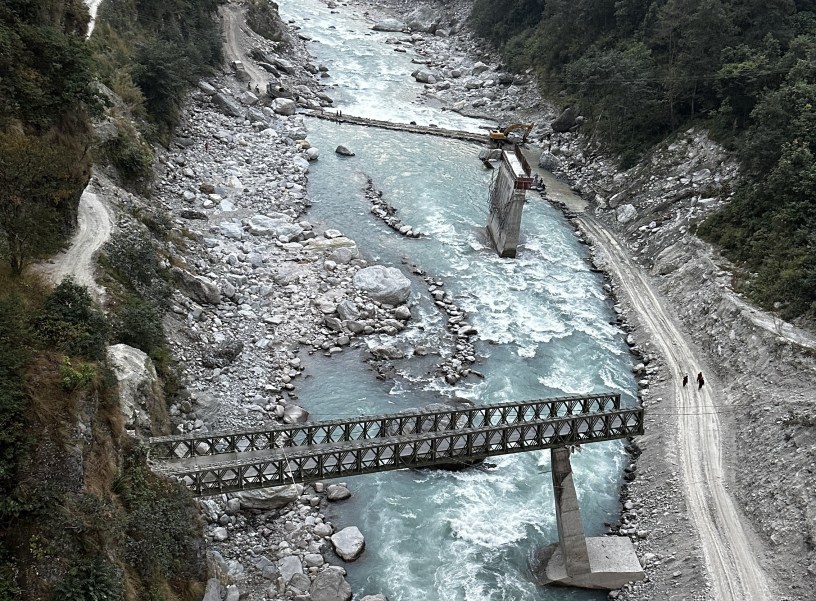
The dilapidated bridge in Solukhumbu exemplifies how Nepal needs not just foreign aid, but better systems for utilizing and maintaining vital infrastructure. @Rakesh Karna. 2025.
This article analyzes trends in foreign assistance to Nepal from 2010 to 2024, examining aid volumes, donor types, sectoral allocations, and alignment with national priorities. It highlights challenges in aid utilization and opportunities to enhance effectiveness as Nepal aims for LDC graduation and SDG achievement, emphasizing the need for strategic approaches to maximize aid’s catalytic potential.
Nepal has long relied on foreign assistance to support its development efforts. Over the past decade, the nature and dynamics of foreign aid to Nepal have evolved significantly, reflecting changing global aid paradigms as well as Nepal’s own development priorities and challenges. This article analyzes key trends in foreign assistance to Nepal from 2010/11 to 2023/24, examining aspects such as aid volumes, types of development partners, sectoral allocations, and alignment with national priorities. It also explores challenges in aid utilization and opportunities to enhance aid effectiveness going forward, particularly as Nepal seeks stakeholder feedback to revise its development cooperation policy.
Aid Volumes and Disbursement Trends
Foreign aid has remained an important source of development finance for Nepal, though its relative share in the national budget has declined over time. In fiscal year 2010/11, foreign aid commitments totaled $1.08 billion, representing about 26% of the national budget[1]. By 2019/20, aid commitments had increased to $2 billion, but this accounted for only about 20% of the budget[2].
The trend of declining relative share continues, as evidenced by the most recent data available for fiscal year 2024/25. Nepal’s government has set a target of receiving approximately $2.05 billion in foreign assistance, comprising $397 million in grants and $1.65 billion in loans[3] [4]. This foreign aid commitment represents about 14.5% of Nepal’s total budget of $14.1 billion for the fiscal year 2024/25[5] [6].
This decline in the relative share of foreign aid in Nepal’s national budget is partly due to the government’s efforts to increase domestic revenue mobilization and reduce dependence on external assistance. However, it’s important to note that while the percentage share has decreased, the absolute value of foreign aid commitments has generally increased over the years, reflecting Nepal’s ongoing need for external support in its development efforts[7] [8]. This trend underscores Nepal’s gradual progress towards greater financial self-reliance while still recognizing the importance of international assistance in its development journey.
A persistent challenge has been the gap between aid commitments and actual disbursements. From 2010/11 to 2019/20, actual disbursements averaged only about 70% of commitments[9]. For instance, in 2018/19, while commitments totaled $2.2 billion, actual disbursements were only $1.6 billion[10]. This disbursement gap has been attributed to factors like delays in project implementation, cumbersome bureaucratic processes, and changing priorities of both donors and the government.
The COVID-19 pandemic disrupted aid flows in 2020/21, with disbursements declining to $1.37 billion[11]. However, aid commitments and disbursements have since rebounded. In 2021/22, aid commitments reached $2.46 billion while disbursements totaled $1.84 billion[12]. The government’s Medium Term Expenditure Framework projects foreign aid to contribute about 18% of the budget in 2023/24[13].
Development Partners and Aid Modalities
Nepal receives foreign assistance from a diverse range of partners, including multilateral institutions, bilateral donors, and international non-governmental organizations (INGOs). The composition of aid providers has evolved over the past decade.
Multilateral institutions have consistently been the largest source of aid, accounting for 60-65% of total disbursements[14]. The World Bank and Asian Development Bank have been the top multilateral donors. Their share has increased from about 40% of total aid in 2010/11 to over 50% in recent years[15]. This reflects a global trend of aid being increasingly channeled through multilateral institutions.
Among bilateral donors, the United States, United Kingdom, Japan, and Germany have been the largest contributors. However, “emerging” donors like China and India have significantly increased their aid in the past decade. China’s aid commitments grew from $19 million in 2010/11 to over $500 million by 2019/20[16]. India’s aid has fluctuated but averaged around $50-100 million annually[17].
The role of INGOs in directly implementing projects has diminished somewhat, in line with aid effectiveness principles of country ownership. INGO disbursements declined from $168 million in 2010/11 to $71 million in 2021/22[12]. However, many INGOs continue to play important roles as technical partners.
In terms of aid modalities, there has been a gradual shift from project-based aid towards more flexible program-based and budget support. The share of budget support increased from 10% of aid in 2010/11 to about 18% in 2021/22[13]. This aligns with Nepal’s preference for aid that can be channeled through country systems. However, project aid still comprises the majority of assistance.
Sectoral Allocation and Alignment with National Priorities
The sectoral allocation of foreign aid has broadly aligned with Nepal’s development priorities, though some mismatches persist. Infrastructure development, particularly in energy and transport, has been a major focus area, accounting for 25-30% of aid disbursements in recent years[18]. This reflects the government’s emphasis on infrastructure as a driver of economic growth.
Education and health have consistently received 15-20% of aid flows each[19]. While this has supported important gains in human development, the government has called for greater aid allocation to directly productive sectors to spur economic transformation. Agriculture, which employs a majority of Nepal’s workforce, has received only about 5% of aid flows[20].
There have been efforts to better align aid with national priorities articulated in periodic plans and the Sustainable Development Goals (SDGs). Nepal’s Development Cooperation Policy 2019 called for at least 70% of aid to be allocated to nationally prioritized areas[21]. Analysis shows improving alignment, with about 65% of aid in 2021/22 going to priority sectors identified in the 15th Plan[22].
Alignment with SDGs has also improved. In 2021/22, about 60% of aid disbursements were explicitly linked to SDG targets, up from 45% in 2016/17[23]. However, some SDGs like climate action (SDG 13) and sustainable cities (SDG 11) remain underfunded relative to needs.
Gender equality and social inclusion have received growing attention, with gender-responsive budgeting applied to aid-funded projects. In 2021/22, 53% of aid disbursements were categorized as directly or indirectly contributing to gender equality, compared to 38% in 2015/16[24]. However, the depth of gender mainstreaming varies across projects.
Climate change has emerged as a key cross-cutting priority. Climate-related aid increased from $68 million in 2013/14 to $533 million in 2021/22[25]. However, this falls short of Nepal’s estimated needs for climate change adaptation and mitigation.
Geographic Distribution and Local Implementation
Historically, foreign aid was concentrated in more accessible areas, exacerbating regional disparities. In recent years, there have been deliberate efforts to channel more aid to remote and disadvantaged regions. The share of aid going to Province 2 (now Madhesh Province) and Karnali Province, two of the poorest regions, increased from 22% in 2016/17 to 31% in 2021/22[26].
The transition to federalism has created both opportunities and challenges for aid effectiveness. While decentralization can potentially improve local ownership and targeting of aid, capacity constraints at provincial and local levels have hindered smooth implementation. In 2021/22, only about 12% of aid was implemented directly by sub-national governments[27].
Implementing agencies for foreign-assisted projects remain predominantly federal line ministries and departments. Key counterparts include the Ministry of Finance for overall aid coordination, National Planning Commission for aligning aid with national plans, and sector ministries like the Ministry of Physical Infrastructure and Transport, Ministry of Energy, Water Resources and Irrigation, Ministry of Education, and Ministry of Health and Population.
Challenges in Aid Utilization
Despite improvements, Nepal continues to face challenges in effectively utilizing foreign assistance:
- Results measurement: While there is increasing emphasis on results-based management, robust systems for tracking and evaluating aid effectiveness are still lacking.
- Low absorptive capacity: Weak institutional capacity, especially at sub-national levels, leads to delays in project implementation and low disbursement rates. In 2021/22, only 69% of allocated foreign aid was actually spent[28].
- Aid fragmentation: Despite commitments to aid harmonization, there is still a proliferation of small projects across multiple donors. In 2021/22, there were over 500 active aid-funded projects[29].
- Sustainability concerns: Many donor-funded projects struggle with sustainability after external support ends. This is partly due to insufficient attention to building local capacity and ownership.
- Coordination challenges: The federal structure has complicated aid coordination, with overlapping mandates between federal and sub-national governments sometimes causing confusion. Unnecessary complications have arisen due to the absence of a transparent, accountable and coordinated grounding of the means, systems and means of implementation under foreign aid.
Way Forward: Enhancing Aid Effectiveness
As Nepal aims to graduate from Least Developed Country status by 2026 and achieve the SDGs by 2030, making every dollar of foreign assistance count is crucial. Several measures can enhance aid effectiveness:
- Strengthen national systems: Emphasis should be placed on efforts to channel large grants, loans, and technical assistance through the national system, including the budget support framework. This helps to increase ownership and sustainability and achieve the goals of national priorities and multi-regional projects.
- Improve project readiness: Address bottlenecks in project preparation to reduce implementation delays. For example in road expansion projects, streamline land acquisition processes and enhance coordination among agencies.
- Enhance sub-national capacity: Invest in building the capacity of provincial and local governments to plan, implement and monitor aid-funded projects. For this, international and Nepali organizations and private sectors should be facilitated and mobilized on priority.
- Focus on catalytic sectors: Prioritize aid allocation to sectors with high potential for economic transformation, job creation and poverty reduction. International and Nepalese organizations and private sectors should be facilitated and mobilized on priority in such sectoral priorities and especially in remote and rural areas.
- Strengthen results frameworks: Develop robust monitoring and evaluation systems to track aid effectiveness and facilitate evidence-based decision-making. At the same time, the priority of assistance will be based on the needs of the country and the local level, and such assistance will be monitored and evaluated on the basis of minimum standards and increased utilization.
- Promote aid transparency: Enhance public access to aid information to improve accountability and citizen engagement. An integrated system should be developed to publicly store and distribute easy and accessible information on all programs and projects carried out under foreign aid.
- Leverage aid for domestic resource mobilization: Use aid strategically to strengthen tax systems and catalyze private sector investment. At the same time, the increase in the quality of public services should be prioritized in proportion to the increase in the scope of taxation.
Conclusion
Foreign assistance continues to play a vital role in Nepal’s development journey, even as the country seeks to reduce aid dependence over time. The past decade has seen positive trends in terms of increasing aid volumes, better alignment with national priorities, and growing attention to cross-cutting issues like gender and climate change.
However, persistent challenges in aid utilization underscore the need for continued reforms in Nepal’s aid management practices. As Nepal pursues its ambitious development agenda, including LDC graduation and SDG achievement, maximizing the catalytic potential of foreign assistance will be crucial.
A strategic approach is essential for Nepal to effectively mobilize foreign assistance and accelerate development. The country must focus on ensuring that foreign assistance makes a substantial and meaningful impact on sustainable and inclusive growth. To achieve this goal, Nepal needs to prioritize the removal of systemic barriers that hinder the efficient use and mobilization of aid funds. Equally important is the establishment and maintenance of appropriate, transparent, and accountable relationships with the various stakeholders involved in the delivery and implementation of development assistance. By addressing these key areas, Nepal can maximize the benefits of foreign aid and create a more robust foundation for long-term progress and prosperity.
(A simplified/edited version of this article in the Nepali language was published in Onlinekhabar on January 27, 2025)
[1] Government of Nepal, National Planning Commission. (2024). Medium-term expenditure framework 2081.
[2] Government of Nepal, Ministry of Finance. (2024). Economic survey 2023/2024.
[3] Rising Nepal. (2025, January 20). Government receives 14.8 percent of foreign grants target in first half. Retrieved from https://risingnepaldaily.com/news/55699
[4] Kathmandu Post. (2024, February 23). Foreign aid spending remains poor compared to use of domestic resources. Retrieved from https://kathmandupost.com/national/2024/02/23/foreign-aid-spending-remains-poor-compared-to-use-of-domestic-resources
[5] NBSM & Associates. (n.d.). Nepal budget highlights 2081-82 (2024-25). Retrieved from https://www.nbsm.com.np/uploads/large/1717217586693600.pdf
[6] Nepal Economic Forum. (n.d.). What’s inside fiscal budget 2081-82: Key highlights and programs. Retrieved from https://nepaleconomicforum.org/whats-inside-fiscal-budget-2081-82-key-highlights-and-programs/
[7] United Nations Development Programme. (n.d.). Nepal’s ODA landscape shifts. Retrieved from https://www.undp.org/nepal/press-releases/nepals-oda-landscape-shifts
[8] Shrestha, M. B. (2023). Foreign aid and economic growth in Nepal. Economic Review of Nepal, 35(1). Retrieved from https://www.nepjol.info/index.php/ern/article/download/72761/55503/211285
[9] Government of Nepal, Ministry of Finance. (2023). Development cooperation report 2021-2022.
[10] Government of Nepal, National Planning Commission. (2024). VNR-2024-Nepal-Report.
[11] ActionAid Nepal. (n.d.). Foreign aid effectiveness study. Retrieved from https://nepal.actionaid.org/sites/nepal/files/publications/ForeignAidEffectiveness_Study_AAIN.pdf
[12] Sharma, K. (n.d.). Foreign aid, governance and economic development in Nepal. Journal of Contemporary India Studies: Space and Society, Hiroshima University. Retrieved from https://www.nepjol.info/index.php/EJDI/article/download/19065/15601
[13] United Nations Development Programme. (n.d.). Nepal’s ODA landscape shifts. Retrieved from https://www.undp.org/nepal/press-releases/nepals-oda-landscape-shifts
[14] Bhattarai, B. P. (2012). Official development assistance in Nepal: A development perspective. E-International Relations. Retrieved from https://www.e-ir.info/2012/08/28/official-development-assistance-in-nepal-a-development-perspective/
[15] Nepal Policy Center for Development. (n.d.). Trend of Nepal’s foreign aid mobilization in different political context. Retrieved from https://ncpd.org.np/news/10/trend-of-nepals-foreign-aid-mobilization-in-different-political-context
[16] Republica. (n.d.). Foreign aid commitment exceeds Rs 200 billion in current fiscal year. Retrieved from https://myrepublica.nagariknetwork.com/news/foreign-aid-commitment-exceeds-rs-200-billion-in-current-fiscal-year-676945cdce31d.html
[17] ActionAid Nepal. (n.d.). Summary on assessment of foreign aid effectiveness sources, uses and development. Retrieved from https://nepal.actionaid.org/sites/nepal/files/publications/Summary%20on%20assessment%20of%20foreign%20aid%20effectiveness%20sources,%20uses%20and%20development…pdf
[18] Republica. (n.d.). Foreign aid: A double-edged sword for Nepal’s development. Retrieved from https://myrepublica.nagariknetwork.com/news/foreign-aid-a-double-edged-sword-for-nepal-s-development
[19] Government of Nepal, Ministry of Finance. (2021). Development cooperation report 2020-2021. Retrieved from https://www.mof.gov.np/uploads/document/file/1696242478_DCR%202020-2021.pdf
[20] Dangal, D. N., Chapagai, S. D., & Ghimire, K. P. (2024). Contribution of foreign aid to GDP in Nepal. Economic Review of Nepal, 7(1-2), 16–23. https://doi.org/10.3126/ern.v7i1-2.72761
[21] Shrestha, R. (n.d.). Foreign aid movements in Nepal. ResearchGate. Retrieved from https://www.researchgate.net/publication/350944477_Foreign_Aid_Movements_in_Nepal
[22] United Nations Development Programme. (n.d.). Development cooperation report. Retrieved from https://www.undp.org/sites/g/files/zskgke326/files/migration/np/Development_Cooperation_Report.pdf
[23] Sapkota, L (2024). AMC Journal of Development, 5(1), 77-87. https://doi.org/10.3126/amcjd.v5i1.69125
[24] World Bank. (n.d.). Nepal overview. Retrieved from https://www.worldbank.org/en/country/nepal/overview
[25] Government of Nepal, Ministry of Finance. (n.d.). Publication detail. Retrieved from https://www.mof.gov.np/site/publication-detail/3293
[26] Thapa, S. B. (n.d.). Contribution of foreign aid to the economic growth of Nepal. ResearchGate. Retrieved from https://www.researchgate.net/publication/378733572_Contribution_of_Foreign_Aid_to_the_Economic_Growth_of_Nepal
[27] United Nations Nepal. (n.d.). Nepal country analysis. Retrieved from https://un.info.np/Net/NeoDocs/View/10739
[28] Subedi, M. S. (n.d.). Assessing the effectiveness of foreign aid and its mobilization in Nepal. ResearchGate. Retrieved from https://www.researchgate.net/publication/358231676_Assessing_the_Effectiveness_of_Foreign_AID_and_Its_Mobilization_in_Nepal
[29] Global Partnership for Effective Development Co-operation. (n.d.). Nepal’s development co-operation policies, systems, reports & mechanisms. Retrieved from https://www.effectivecooperation.org/nepals-development-co-operation-policies-systems-reports-mechanisms
 Rakesh Karna